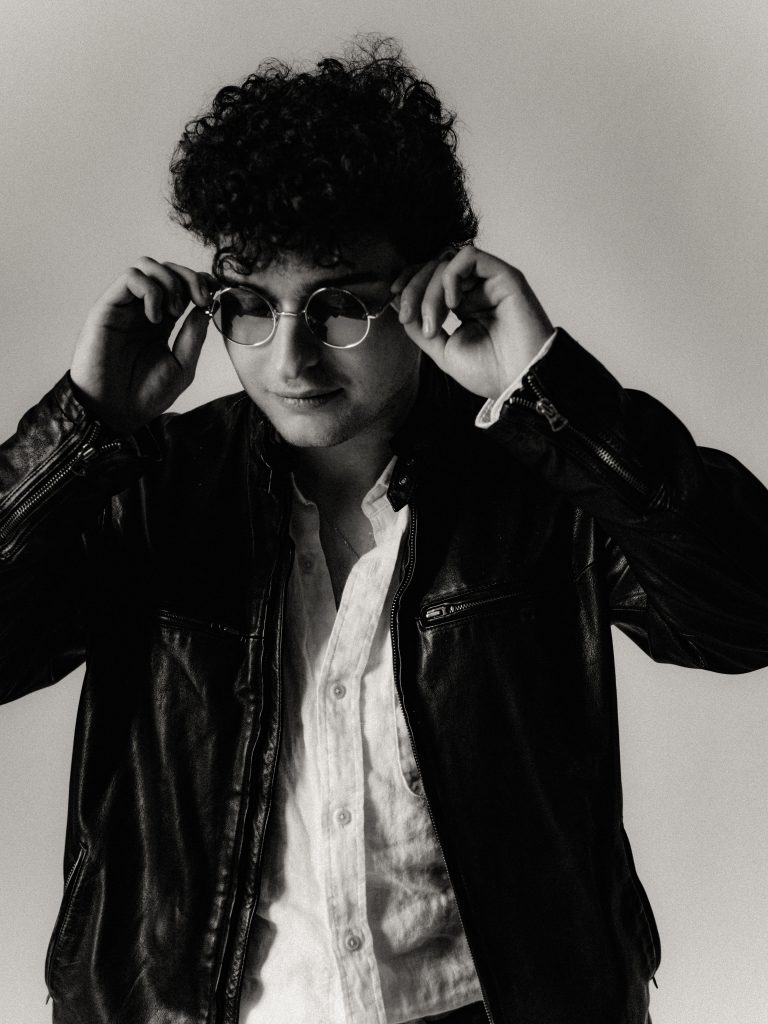
Joshua Pearlstein’s “Wanna Dance” opens with a sense of immediacy that feels almost instinctual, as though the track bypasses deliberation and moves straight into motion. From the first few seconds, there is a kinetic urgency embedded in its structure—a rhythmic pulse that feels less like accompaniment and more like the song’s central nervous system. This is not a track that builds slowly toward engagement, but asserts itself from the outset, pulling the listener into a tightly constructed sonic environment where movement becomes both subject and function. For Pearlstein, an Atlanta-raised and Los Angeles-based artist still early in his career, “Wanna Dance” represents a notable moment of clarity, one that shifts focus away from technical exhibition and toward something more elemental: the desire to feel, to move, and to let go.
The production is central to this effect, balancing mechanical precision with an undercurrent of warmth that prevents it from feeling sterile. Deep, resonant basslines anchor the composition, while layered synths—slightly distorted and constantly evolving—create a sense of restless momentum. The track operates on a principle of tension and release, with verses that feel tightly coiled, holding energy in reserve before the chorus opens into a more expansive melodic space. This push-and-pull dynamic gives the song its structural identity, allowing it to maintain forward motion without becoming predictable. The involvement of mixer Yianni AP and mastering engineer John Greenham is evident in the track’s polished finish; every element occupies its own space within the mix, resulting in a sound that feels three-dimensional without losing its raw edge.
Lyrically, “Wanna Dance” embraces simplicity as a form of honesty. The repeated refrain, “I just wanna dance,” functions as a hook and a declaration, distilling the song’s intent into a single, unambiguous statement. Yet beneath this apparent simplicity lies a deeper resonance. Lines like “All the lights are going out now” introduce a subtle tension, suggesting a moment of disconnection or collapse that precedes the act of dancing. In this context, movement becomes a form of resistance—a way of reclaiming agency in the face of external pressures. Pearlstein’s vocal delivery reinforces this duality, carrying a certain grit that grounds the track emotionally. His performance is charismatic and intimate, navigating the line between personal confession and collective anthem with notable ease.
Ultimately, “Wanna Dance” succeeds because it understands the power of focus. Rather than attempting to be everything at once, the track commits fully to its central idea, exploring it through sound, structure, and performance. This sense of purpose gives the song a coherence that elevates it beyond standard electro-pop fare. It feels like a deliberate step forward for Pearlstein, one that reflects his technical growth and his evolving artistic identity. In choosing to centre his work around the act of dancing—not as spectacle, but as emotional release—he taps into something universally relatable. The result is a track that resonates not through complexity alone, but through its ability to translate feeling into motion, offering listeners a space where sound and sensation converge with striking clarity.
Connect with Joshua Pearlstein
WEBSITE
YOUTUBE
SPOTIFY
SOUNDCLOUD
INSTAGRAM
TIKTOK