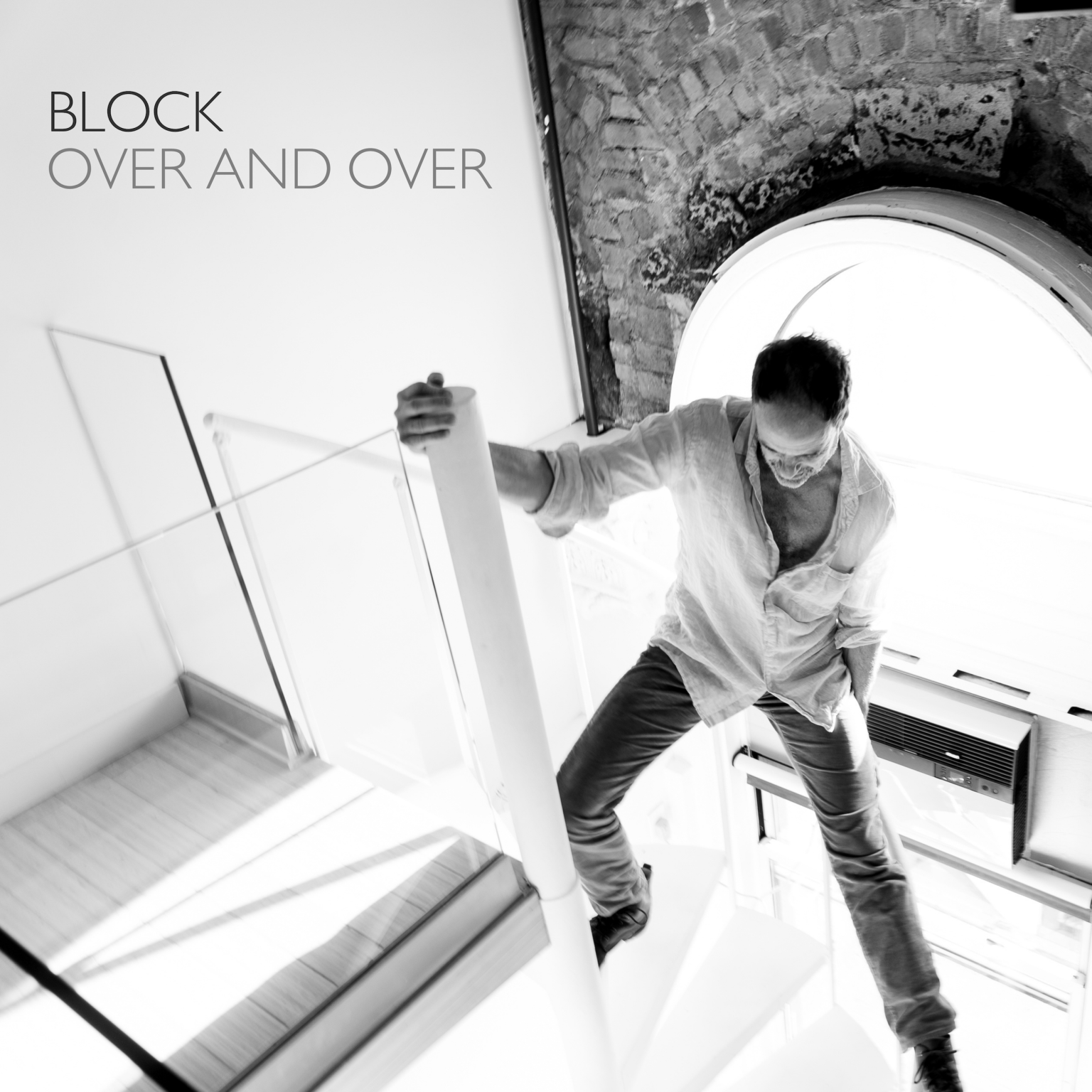
From the first fragile seconds of “Over And Over,” it’s clear this track doesn’t ease itself into your ears, but settles into your nervous system. Built on a deceptively simple framework, the song feels like a mind pacing in a small room, circling the same thoughts, the same fears, the same questions, unable to escape yet refusing to look away. That tension—between restraint and collapse—is where BLOCK has always done his most vital work, and here it feels distilled to its rawest form. The production, guided by Chris Kuffner’s sensitive hand, allows space to function as an instrument. The drum loop—born from a road-side soundcheck and sent back like a lifeline—ticks with an almost anxious insistence, mirroring the lyrical theme before a single word is fully absorbed. This enacts, pulling the listener into the loop rather than describing it from a safe distance.
Lyrically, “Over And Over” may be BLOCK’s most emotionally naked moment to date. His admission that the song emerged during a period of acute psychological distress—shaped by lifelong OCD—casts the track in a stark, unromantic light. There’s no metaphorical fog here, no clever deflection. The words land, plain and almost brutal, as if polished language would be dishonest to the experience itself. BLOCK has long been praised for his wit and intelligence, but what makes this track so powerful is his willingness to step away from cleverness and let discomfort speak for itself. You can hear the song being written as it’s performed—the urgency, the lack of overthinking, the sense that if it didn’t come out right then, it might not survive the day. The melody doesn’t soar so much as it endures, moving forward because it has no other option. In that way, “Over And Over” becomes less a composition and more a document: proof that survival sometimes sounds messy, unresolved, and frighteningly honest.
Musically, the track sits comfortably within BLOCK’s lineage while still pushing into darker, less charted emotional territory. Echoes of the anti-folk movement he helped define are present—the intimacy, the refusal to sanitise pain—but they’re filtered through decades of lived experience and artistic evolution. The lo-fi sensibility is purposeful rather than nostalgic, a choice that keeps the listener close enough to hear the cracks in his voice and the weight behind each phrase. Blake Morgan’s mixing and mastering ensure that nothing is smoothed over unnecessarily; every breath, every slight imbalance feels intentional, even essential. This is not a song designed for passive listening. It demands attention, not through volume or drama, but through emotional gravity. Much like artists such as Regina Spektor or Ani DiFranco, BLOCK understands that vulnerability isn’t a weakness, but a form of authority. When he sings, you believe him, not because the song is pretty, but because it’s true.

Placed within the broader context of BLOCK’s resurgent career—bolstered by Meridian’s meticulous reissues and a growing new audience—“Over And Over” feels like a reckoning and a bridge. It connects the restless, boundary-breaking spirit of his early work with the hard-earned clarity of an artist who has survived his own mythology. As a preview of Love Crash, the song suggests an album shaped not by ambition, but by necessity—a ladder built rung by rung out of darkness. There’s something profoundly human about that, and profoundly rare. In an era where vulnerability is often stylised and packaged, BLOCK offers something riskier: an unfiltered look at what it means to live inside your own head, day after day. “Over And Over” doesn’t promise resolution. It doesn’t pretend healing is linear. Instead, it stands as a quiet, courageous act of witness—one that lingers long after the final note fades, looping in your mind the same way it was born in his.