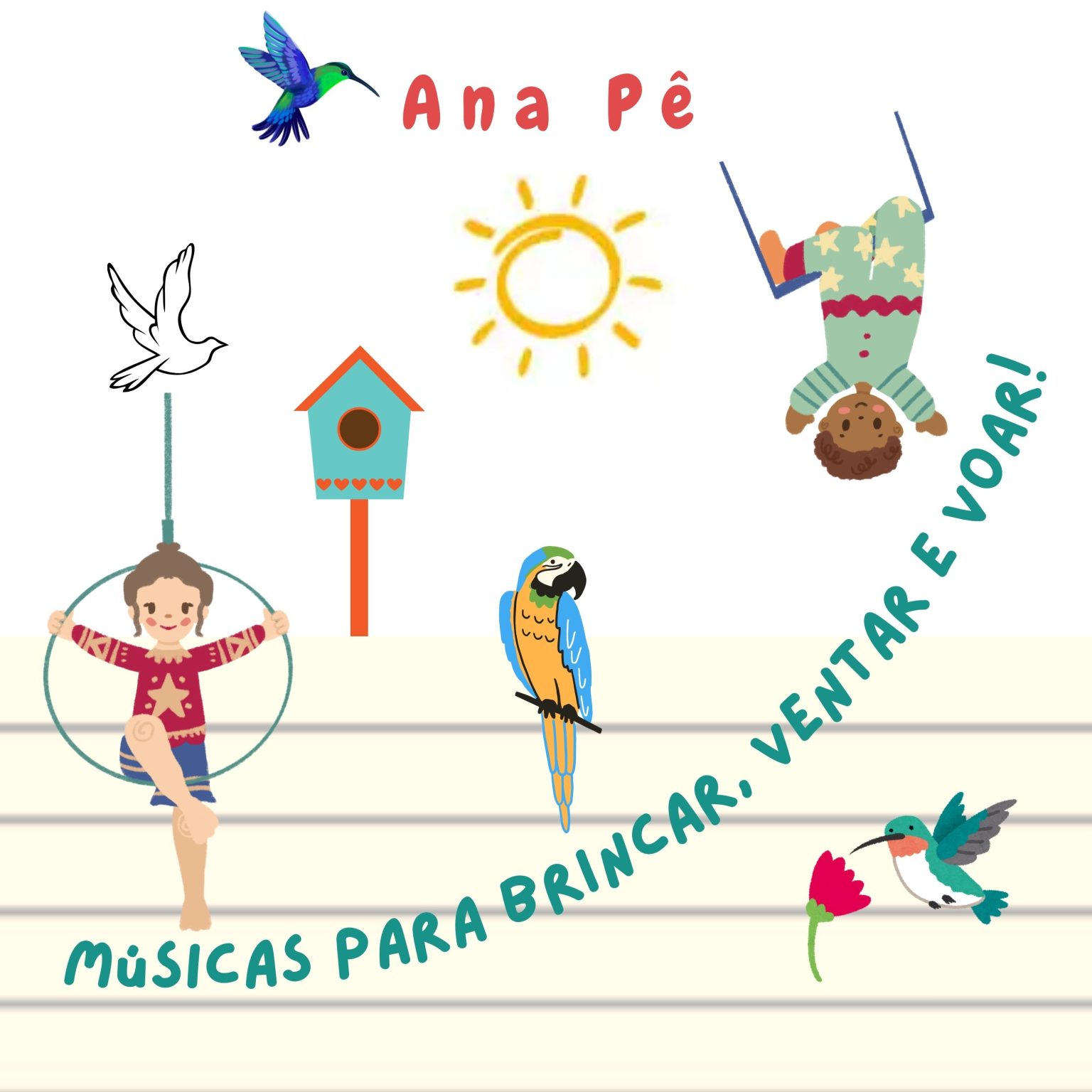
Too often music for children is dismissed as nothing more than a bright distraction to keep young minds occupied for a few fleeting minutes. But the best of the genre has always done something far more important. It has sparked curiosity. It has inspired compassion. It has taught the greatest lessons of life through melodies that children happily carry with them long after the music has faded. Ana Pê’s debut album, Music to Play, Blow, and Fly! “Songs to Play, Breeze and Fly!” squarely belongs in that noble tradition. The Brazilian actress, theater educator, performer, and multidisciplinary artist transform childhood into a colorful landscape, where imagination, emotional intelligence, and human connection go hand in hand in nine beautifully crafted songs. Ana Pê does not talk down to children or dumb down complicated emotions. She has full faith in her audience, talking to young listeners—and the adults sitting next to them—about identity, empathy, courage, loss, and hope. This is a tribute to the true spirit of childhood: exploration without fear, learning through play, and growing through kindness.
And that is because Ana Pê has a really fantastic background. She has completed doctoral research into the intersection of the performing arts and adolescent mental health and has over twenty-five years of experience in theater, education, and artistic expression. Each piece has the ring of something written from experience rather than from theoretical notions of what children should like. It eschews gimmicks and overdone and over-the-top novelty and tells stories that respect the intelligence of kids and make every lesson approachable through warmth and creativity. The record is blessed with an impressive musical richness thanks to the wonderful production of the acclaimed guitarist Luiz Brasil and the arrangements he shared with the renowned saxophonist Daniela Spielmann. March rhythms, chote, MPB, baião, rock, blues, and ska freely mix to create a colorful sonic landscape that reflects Brazil’s immense musical heritage but is also instantly appealing to listeners of any age. Each instrument choice is a careful consideration of both the educational impact and the pure musicality.
The album begins with “Bloco das Crianças,” which makes clear from the start its guiding philosophy and one of the most joyous cultural traditions in Brazil. The song captures the spirit of the carnival blocos, reinventing childhood as a colorful parade where everyone is invited, no matter their class, looks, or personality. Diversity is not a social responsibility; it is a celebration of the source of our happiness. The infectious rhythm naturally encourages movement, singing, and participation, reinforcing the point that community is strongest when everyone is invited to the party. A joyful introduction, this leads Mãe Natureza into a light meditation on environmental consciousness. Ana Pê does not present ecological responsibility as something to fear or a guilt to carry, but instead with affection and gratitude for nature. Earth is a loving parent of love. And children are invited to grow from love, not duty, into respect for the environment. This tenderness spills directly into “Meu Corpo, Meu Templo Sagrado,” one of the most courageous moments on the album. The song is a delightful way to teach kids about body autonomy, consent, and self-care. It uses poetry instead of a lecture and presents a positive way to think about personal boundaries. Ana Pê has a rare gift for taking essential lessons and making them feel natural, comforting, and deeply affirming in a musical landscape where these conversations are so often avoided altogether.
The album explores the emotionality of songs that talk about subjects not usually found in children’s music. “Who Said Boys Don’t Cry?” asks one beautifully simple question about tired notions of masculinity: who said boys can’t cry? It is not a lecture but a gentle deconstruction of negative stereotypes, which makes you feel that honesty is a sign of strength and not weakness. “It’s a powerful invitation to all children, boys and girls, to be vulnerable without shame.” “Mirror, Mirror on the Wall” takes familiar fairy tale imagery and uses it to explore self-esteem, changing the mirror from a symbol of comparison to one of self-acceptance. A song that reminds us that true beauty comes from knowing your own special worth, not from measuring it against impossible standards. Another creative angle is “Desenho Cego,” which uses the concept of blind drawing to promote empathy, encouraging children to appreciate perspectives beyond their own. Ana Pê teaches one of life’s most important lessons, quietly, through the playful act of creativity: that to understand others, we must first accept that everyone sees the world differently.
Maybe the song with the most emotional resonance on the album is “Caminho do Mar.” It takes an exceptional hand to approach grief in children’s music, and Ana Pê deals with the subject with such wonderful grace. The song doesn’t attempt to erase the sadness or offer quick fixes. It embraces loss as part of life and subtly reveals the hope that resides alongside it. Here the sea imagery is particularly poignant. The sea is about movement, memory, and continuity. People may leave our lives in the physical sense, but love continues to flow, like the tides that return to shore forever. This emotional maturity carries naturally into “Passarinho Branco,” where freedom becomes both literal and symbolic. White Bird Soaring is a symbol of dreams, resilience, and possibility, inspiring children to believe in their own power to grow and trust the journey ahead. And “Gira da Alegria” closes the album the way childhood should end: with laughter, movement, celebration, and uninhibited play. The album touches on themes of belonging, care for the environment, consent, emotional vulnerability, empathy, grief, and freedom before ending with a reminder that joy itself is an important part of mental health.
Musically, Músicas para Brincar, Ventar e Voar! is as gripping as its lyrical vision. is as gripping as its lyrical vision. is as gripping as its lyrical vision. is as gripping as its lyrical vision. Luiz Brasil’s production radiates warmth and sophistication without ever becoming overly polished or detached. Organic instrumentation breathes naturally throughout the record, while Daniela Spielmann’s arrangements introduce beautiful melodic flourishes that enrich every composition. Contributions from accomplished musicians including Charles Gavin, Beatriz Rabello, Thelmo Fernandes, Bruno Ganem, João Rafael, Lon Bové, Leonardo Reis, and João Tavares Lopes elevate the performances without overshadowing the songs’ intimate emotional focus. Every rhythm feels alive, every melody memorable, and every arrangement thoughtfully designed to support storytelling rather than distract from it. The stylistic diversity of the most educational album’s contribution. Instead of restricting young listeners to a single musical vocabulary, Ana Pê introduces them to a rich spectrum of Brazilian musical traditions alongside blues, rock, and ska influences. The result is an album that stimulates both emotional and musical curiosity, inviting repeated listens where new instrumental details reveal themselves with every return.
What is so remarkable about this debut is its unshakeable belief in children’s emotional resources. Many albums for younger ears shy away from complexity, for fear that a difficult subject matter will be too much for their audience. Ana Pê goes the other way. She knows that kids are already grappling with grief, insecurity, fear of their surroundings, questions of who they are, and so much more before they even reach adulthood. She does not deny these experiences but offers language, melodies, and stories to support children in moving through these experiences with compassion. And the album is never ponderous or over-instructional. Each important lesson is cloaked in catchy rhythms, imaginative metaphors, and playful arrangements that keep the wonder coming throughout. The delicate balance between education and entertainment is impressive in its artistic maturity; each message feels organic and not forced.

The album also succeeds in demonstrating the inextricable relationship between art and mental health. Every carefully constructed composition bears the mark of Ana Pê’s experience as a theater educator and researcher. Music is at the same time a conversation, an exercise of emotions, a playground of imagination, and a space for healing. Listening is active, not passive; children are encouraged to think, ask, answer, and gain their confidence in their creativity. With rare sincerity, the songs cross generations, and parents, teachers, and caregivers are as likely to find themselves moved as the children sitting next to them. In a world increasingly ruled by distraction and instant gratification, Músicas para Brincar, Ventar e Voar! gently reminds us that we build resilience by listening, playing, imagining, and relating to each other.
More Read



In the end, Músicas para Brincar, Ventar e Voar! is a beautiful artistic achievement that exceeds the usual expectations of children’s music. It is a record of laughter, unafraid of tears, playful and deeply thoughtful, unmistakably Brazilian and universally human. Ana Pê has created an album where every melody has a reason, every lyric calls for reflection, and every rhythm celebrates the extraordinary emotional wealth of childhood. With incredible musicianship, caring storytelling, and unflinching honesty, she uses music as a space for kids to learn not only how to sing and dance but also how to know themselves and others with compassion. Músicas para Brincar, Ventar e Voar! is, in this way, an honest companion for growing up and shows that the best children’s albums help create more caring, courageous, and compassionate human beings, one unforgettable song at a time.