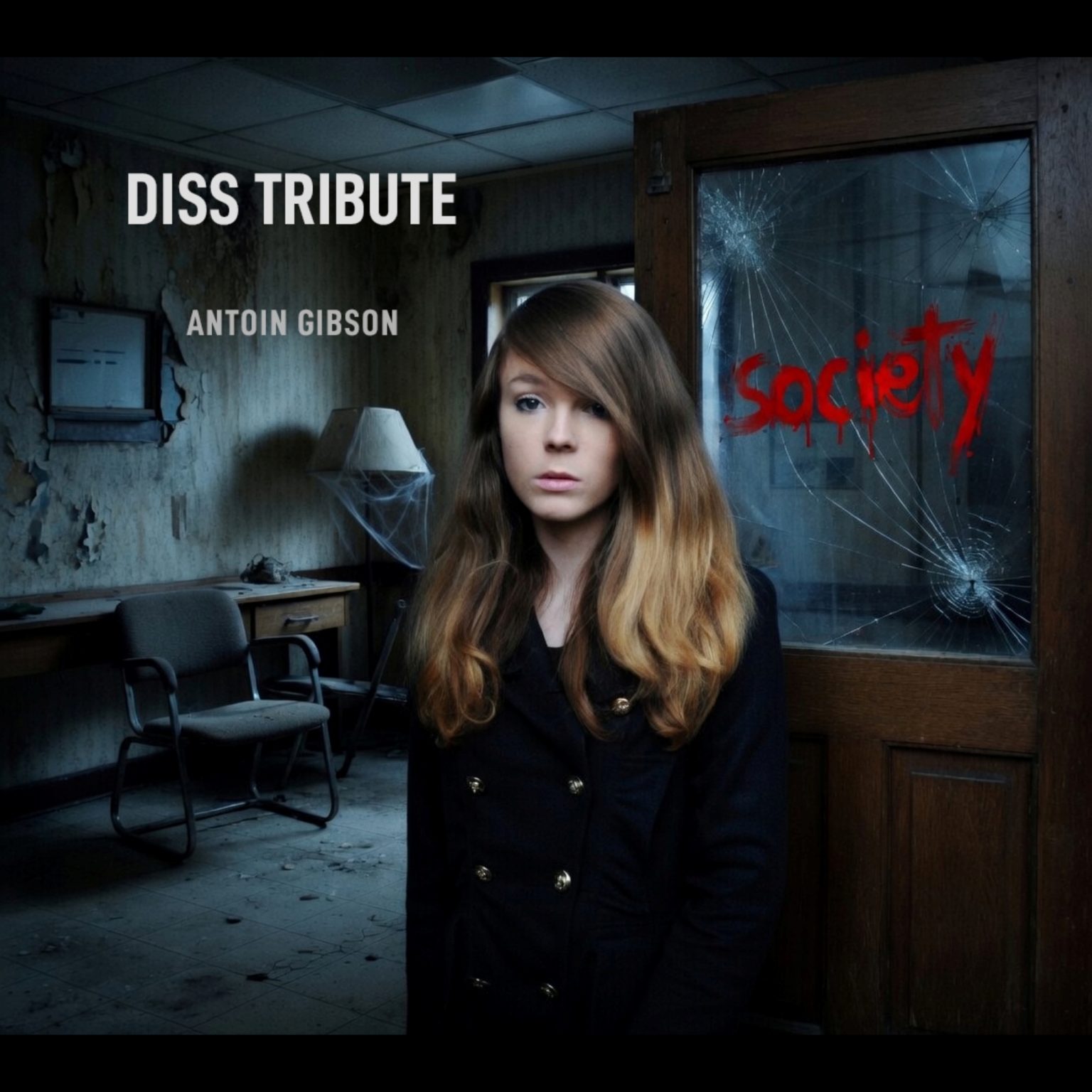
Antoin Gibson’s “Diss Tribute” arrives as a calculated intervention in the evolving mechanics of the music industry. Marking the first anniversary of her viral debut FlexAble, this release signals a decisive shift in both tone and strategy, positioning Gibson as an artist who understands the architecture behind visibility as much as the art itself. Based in London and increasingly recognised for her conceptual precision, Gibson uses “Diss Tribute” to challenge the norms of distribution and recognition. By prioritising sync placements across platforms such as television networks and major media channels before traditional streaming metrics, she inverts the expected trajectory of success. This reversal is purposeful, reflecting a broader critique of how artistic value is measured in an era dominated by algorithms.
Lyrically, “Diss Tribute” is sharp, unflinching, and deeply aware of its context. Gibson‘s delivery is stripped back, almost confrontational, allowing each line to land with clarity and intent. The track interrogates the transition from organic virality—once seen as the hallmark of authenticity—to a system where opaque digital structures increasingly mediate exposure. There is an undercurrent of frustration, but it is channelled into analysis rather than complaint. Gibson dissects the mechanisms of suppression, authorship, and control with a precision that feels intellectual and visceral. Her approach rejects passive listening, instead demanding engagement from the audience. This music insists on attention, asking listeners to consider not just what they hear, but the systems that determine why they hear it at all.
The production mirrors this ethos of intentionality. Minimalist in design, the beat creates a stark backdrop that amplifies Gibson’s voice rather than competing with it. There is a deliberate absence of excess—no ornamental layers, no unnecessary embellishments—just a focused sonic environment that reinforces the track’s thematic weight. This restraint allows the song’s structure to take centre stage, highlighting the interplay between rhythm and rhetoric. As part of her “C U Next Tuesday” release schedule, “Diss Tribute” also functions as a timestamp, anchoring itself within a broader, ongoing narrative. It becomes clear that Gibson is not operating within isolated moments but constructing a continuum where each release builds upon the last, contributing to a larger artistic and strategic framework.

Ultimately, “Diss Tribute” stands as a critique and manifesto, encapsulating Antoin Gibson’s evolving identity as an artist who refuses to be confined by traditional industry pathways. It is a work that acknowledges the constraints of the current landscape while actively seeking to navigate—and subvert—them. By turning suppression into a form of leverage and redefining how success can be achieved, Gibson offers a compelling alternative to the status quo. The track’s impact lies not only in its sound or message, but in its method: a demonstration that control, when reclaimed, can be as powerful as any viral moment. In this sense, “Diss Tribute” is less about opposition for its own sake and more about reconfiguration—an assertion that the rules of engagement are not fixed, and that artists like Gibson are capable of rewriting them on their own terms.
Connect with ANTOIN GIBSON
WEBSITE
SPOTIFY
SOUNDCLOUD
INSTAGRAM
BANDCAMP