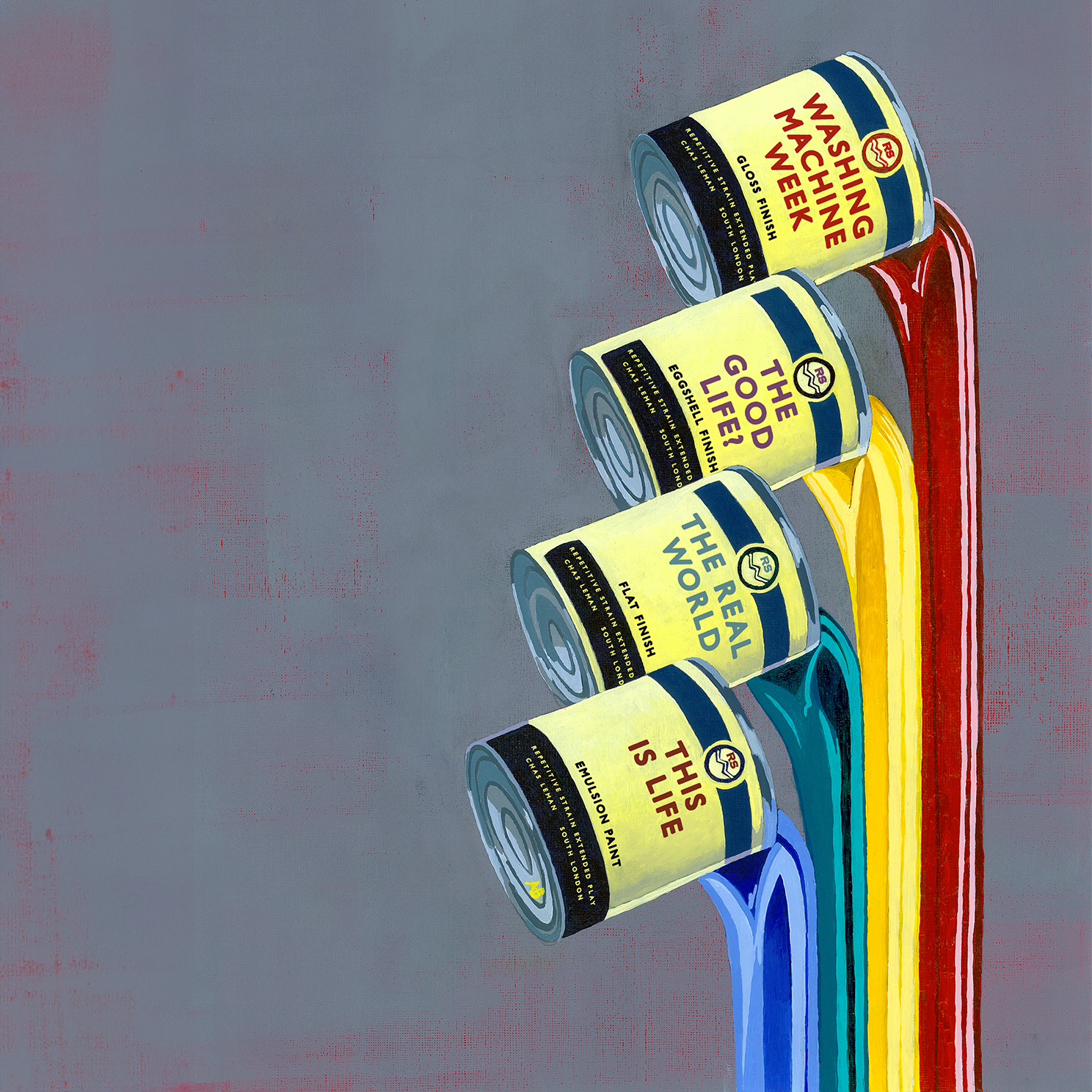
After the sharp-witted, retro-leaning theatrics of his 2025 debut Wish The Clock Would Go Back, Chas Leman pulls a dramatic handbrake turn with his new EP REPETITIVE STRAIN. Where the previous record channelled the spirit of Elvis Costello, early David Bowie, and Jarvis Cocker through organic instrumentation and classic songwriting structures, this latest release dives headfirst into programmed beats, looping basslines, and richly textured synthscapes. It’s a bold pivot—but not a reckless one. Instead, it feels like an artist finally stepping into a long-held ambition. Inspired by formative listens to Original Pirate Material by The Streets and the debut Gorillaz album, Leman has long dreamed of crafting a loop-driven, electronically anchored project. Now, teaming up with producer A. Charles, that dream materialises in a four-track EP that feels nostalgic for the 2000s indie-electronica boom while sounding fiercely contemporary in its social commentary.
Opening track “WASHING MACHINE WEEK” sets the tone with a thick, pulsating bassline that drives forward with mechanical persistence—an apt sonic metaphor for the grind of a 9-to-5 existence. The production is layered and playful: padded synths hum beneath the surface, while unexpected touches of oriental lutes and Eastern European dulcimers give the track a vibrant, almost surreal quality. Yet despite the colourful instrumentation, there’s a persistent melancholy in Leman’s vocal delivery. His voice carries the weary wit of a crooner who’s seen behind the curtain of modern life. Lines like “we’ll dance to the beat of the leaky tap, and sing to the sound of the draft through the gaps in the doors” evoke humour and hardship, echoing the observational sharpness of Jarvis Cocker without descending into imitation. It’s a danceable lament—a celebration of making do in a world that feels increasingly unaffordable.
The second track, “THE GOOD LIFE?”, sharpens the EP’s anti-capitalist edge while remaining irresistibly buoyant. Built on punchy drum loops and modulated Bossa Nova-style guitar work, the song layers Eastern string motifs into its hook, creating a textured and immersive sonic world. On the surface, it’s indie-pop ready for the dance floor, but lyrically it’s a critique of shrinking community spaces and the quiet erosion of working-class leisure in the UK. Leman reels off images of local pleasures gradually commodified or erased, turning nostalgia into protest. Yet even here, the mood isn’t entirely bleak. There’s a celebratory resilience woven into the rhythm—a sense that even when systems fail people, people find ways to endure. The tension between groove and grievance gives the track its emotional charge.
If the first two songs lean into accessibility, “THE REAL WORLD” ventures further into experimentation. This is where Leman and A. Charles pushes their sonic palette into more abstract territory. Manipulated and layered vocals swirl around electronic loops, creating a dense, almost hypnotic atmosphere. The track feels less concerned with hooks and more invested in mood and progression. Yet beneath the experimentation lies a complex chord structure that reveals Leman’s continued commitment to musical depth. Thematically, the song zooms out from personal drudgery to global uncertainty, contemplating the direction of humanity in an era defined by instability and digital overload. It’s ambitious without being self-indulgent, bold without losing coherence—a testament to the chemistry between artist and producer.
Closing track “THIS IS LIFE” serves as the EP’s emotional and conceptual centrepiece. It begins sparsely, with single-note synth pulses and raspy, direct vocals that feel almost confrontational in their honesty. As the song builds, layers accumulate—drums intensify, synths swell, and the chorus erupts into an anthemic declaration: “This is life, on the shop floor, this is life, full of locked doors, this is life ever wondering if there’s more?” The repetition of the phrase “This is life” lands like a resignation and rallying cry. It acknowledges the monotony while refusing to be crushed by it. The track culminates in an instrumental outro featuring duelling guitars—one channelling low-end rockabilly twang, the other slicing through with angular indie-pop sharpness. It’s a thrilling finale that underscores the collaborative spark between Leman and Charles.

What makes REPETITIVE STRAIN particularly compelling is its balance of critique and celebration. Leman is clear that the EP isn’t meant to wallow in negativity, but highlights human adaptability—the almost animalistic drive to survive and persist even when dreams are sidelined by economic reality. The anti-capitalist sentiment runs strong, but it’s delivered with wit, groove, and a surprising sense of warmth. The record invites listeners to dance in defiance. That duality—cynicism paired with rhythm, frustration wrapped in melody—gives the EP its unique pulse.
In just four tracks, Chas Leman proves he’s unwilling to settle into a predictable lane. REPETITIVE STRAIN expands his sonic universe, revealing a deeper and more versatile palette than many might have expected after his debut. It’s nostalgic without being derivative, political without being preachy, and electronic without losing the human core that defines his songwriting. As he prepares to take these songs to intimate stages like Brighton’s The Bees Mouth and London’s Battersea Barge, one thing is certain: Leman is carving out a space among artists who refuse the easy path. If this EP is any indication, the only repetition in Chas Leman’s career will be his commitment to reinvention.
Connect with Chas Leman
WEBSITE
SOUNDCLOUD
YOUTUBE
SPOTIFY
BANDCAMP
INSTAGRAM