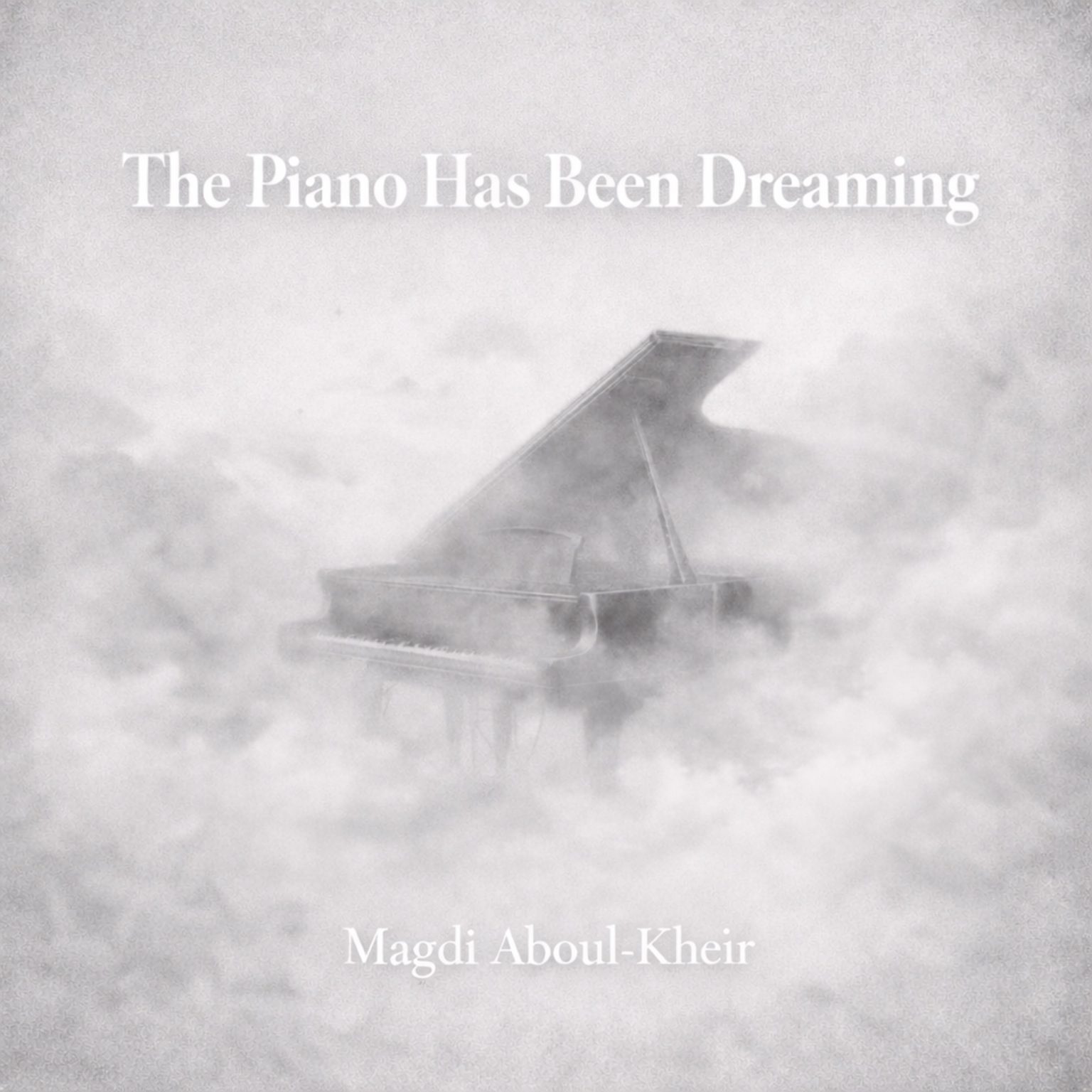
Magdi Aboul-Kheir’s The Piano Has Been Dreaming is a rare kind of record—one that invites the listener into a deeply private, contemplative space. Across eight compositions and a concise 29-minute runtime, the album unfolds with remarkable intentionality, offering an experience that feels less like a performance and more like a quiet conversation with memory itself. Built primarily around the tonal warmth of a grand piano and the delicate textures of felt keys, the project occupies a subtle intersection between classical sensitivity and modern cinematic stillness. It is an album that understands the emotional power of restraint, allowing silence to function not as absence, but as an integral part of its expressive language.
The opening track, “Echoes of Tenderness,” immediately establishes the album’s intimate tone. Its soft phrasing and measured pacing create a sense of emotional proximity, as though the listener has been invited into the composer’s inner world. There is a conversational quality to the piece, where each note feels carefully placed, not to impress, but to communicate. This sense of quiet dialogue continues into “Beauty, Wine, and Truth,” where the melodic lines stretch slightly further, offering a gentle expansion of the album’s emotional palette. Rather than disrupting the calm established in the opening, the track deepens it, introducing a reflective warmth that feels like a pause between unspoken thoughts. Together, these early compositions set the foundation for an album that prioritises nuance over declaration.
“Letters Never Sent” builds upon this foundation by introducing a more pronounced sense of longing. The piece carries an emotional weight that is subtle and deeply affecting, evoking the idea of unfinished conversations and unresolved connections. Its melodic structure feels almost literary, as though each phrase corresponds to a sentence left incomplete. This introspective quality is further developed in “Sanctuary of Dreams,” the album’s longest composition, which expands the sonic landscape while maintaining its core intimacy. Here, Aboul-Kheir leans into a more cinematic sensibility, allowing the music to unfold with a quiet grandeur that never loses sight of its emotional centre. The track feels immersive, creating a space where the listener can linger without the pressure of resolution.
As the album progresses, “Gravity of the Heart” marks a subtle yet significant shift in tone. There is a groundedness to the composition, a sense that the music is reaching deeper into personal terrain. The emotional gravity suggested by the title is reflected in the weight of the harmonies, which feel more anchored and deliberate. Yet, even at its most intense, the piece maintains the album’s overarching sense of restraint. This balance is what gives the record its distinctive character—the ability to convey depth without excess. The transition into “The Shadow’s Shadow” further expands this dynamic, introducing a darker, more enigmatic atmosphere. Through slight harmonic shifts and a more brooding tonal palette, the track explores the hidden layers of memory, suggesting that not all reflections are illuminated.
“Last Light and Fading Thoughts” offers a moment of quiet recalibration, returning to a more meditative space while retaining the emotional complexity established in the preceding tracks. The use of repeating arpeggios creates a sense of continuity, as though the music is gently circling its own ideas. This looping quality lends the piece a mantra-like effect, encouraging a state of introspection that feels calming and profound. It is a track that does not seek to resolve the album’s themes, but rather to hold them in suspension, allowing the listener to engage with them on their own terms. This approach reinforces the album’s commitment to openness, resisting the urge to impose a singular narrative.
The closing composition, “Eternal Home,” serves as a fitting conclusion to this carefully constructed journey. There is a sense of arrival within the piece, not in the form of a definitive resolution, but as an emotional acknowledgement. The higher register of the piano introduces a more ethereal quality, suggesting a movement toward something beyond the tangible. It feels expansive, almost cosmic, yet remains grounded in the intimacy that defines the album as a whole. This balance between the personal and the universal is one of the record’s most compelling qualities, allowing it to resonate on multiple levels simultaneously.
From a production standpoint, The Piano Has Been Dreaming exemplifies clarity and purpose. Every note feels considered, every pause intentional. The use of felt piano textures adds a layer of softness that enhances the album’s introspective tone, while the overall recording maintains a sense of immediacy that draws the listener closer. There is no excess here, no unnecessary embellishment. Instead, the focus remains firmly on the emotional content of the music. This disciplined approach to composition and production underscores Aboul-Kheir’s understanding of his medium, demonstrating that complexity need not be achieved through density.

What ultimately distinguishes this album is its ability to create a fully realized emotional arc within such a limited timeframe. Each track contributes to a broader narrative that explores themes of love, loss, memory, and quiet acceptance. Yet, the album never feels constrained by its brevity. On the contrary, its conciseness enhances its impact, ensuring that each moment carries weight. This is music that rewards attentive listening, revealing new nuances with each revisit. It does not demand repeated plays, but it invites them, offering a depth that unfolds gradually over time.



In its entirety, The Piano Has Been Dreaming stands as a testament to the expressive potential of minimalism. Magdi Aboul-Kheir has crafted a work that is deeply personal and universally resonant, using the piano as a vehicle for emotional exploration rather than technical display. It is an album that trusts in the listener’s ability to engage with subtlety, to find meaning in quiet spaces, and to appreciate the beauty of restraint. In doing so, it achieves something increasingly rare in contemporary music: a sense of stillness that feels not empty, but profoundly alive.
Connect with Magdi Aboul-Kheir
FACEBOOK
SPOTIFY
SOUNDCLOUD
BANDCAMP
INSTAGRAM