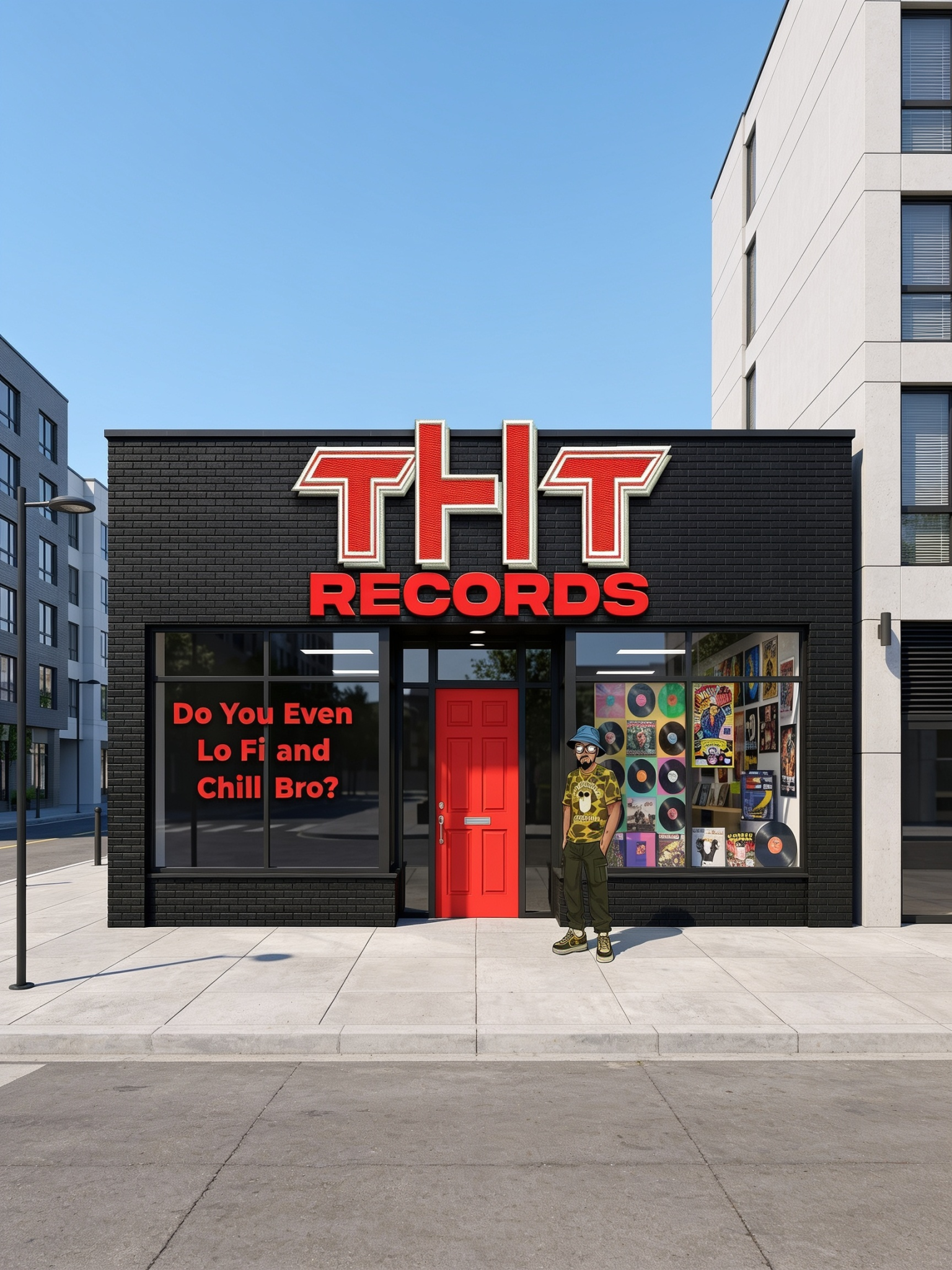
There’s something oddly compelling about an album called Do You Even Lo Fi and Chill Bro? Because the question is a joke, a challenge, and a mission statement, all at once. But for Miami-based producer and artist Traes His Traxx, the title means something far more serious: the culmination of years spent making music that wouldn’t neatly fit inside somebody else’s genre box. Out July 29, 2026: Do You Even Lo-Fi and Chill, Bro? The first in a planned series, Vol. Uno arrives, introducing a wonderfully unpredictable world where lo-fi, chillwave, alternative hip hop, experimental production, and traces of electronic music all co-exist without asking permission. The album is the sound of an artist who has finally got a space to lodge his aberrant creative instincts, both culturally and sonically. Traes refers to his method as “Aggressively Beautiful©,” and the phrase aptly describes the project’s inherent contradiction. Softness but also impact, relaxation but also rhythmic intensity, hazy atmosphere but also a restless imagination that cannot sit still. Traes crafts music for late-night headphones, lonely road trips, weird conversations, creative processes, and those times when the world gets quiet and your mind gets loud across nine tracks. To him, lo-fi and chillwave aren’t strict formulas but launchpads, extending the familiar textures of each into something distinctly his own. The end result is an album that feels fun but not frivolous and experimental but not esoteric.
It makes sense to think of that sense of being unique when you consider Trae’s His Traxx coming from Queens, New York, to Miami, Florida. He’s produced everything from EDM to 90s Boom Bap, and his production history is all over the place on Do You Even Lo Fi and Chill Bro? He doesn’t throw away his old influences for what’s hot now but incorporates them into the atmospheric vocabulary of lo-fi and chillwave. That gives the album an exceptionally rhythmic backbone. The warm textures and laid-back surfaces conceal percussion patterns that have real visual character and are constantly changing and interacting with the surrounding soundscape. It doesn’t feel like Traes is just putting sounds on a grid, but rather creating an environment in which each texture is moving. That philosophy is why the album doesn’t sound like some generic mash-up of sleepy beats. There’s too much personality in the arrangements. The tracks breathe and twitch and float and collide and sometimes surprise you with a left turn just when you think you have them figured out. Even at its more subdued moments, the album is propulsive. Chill music isn’t necessarily passive. Sometimes relaxation is tension, curiosity, humor, or even a little chaos. Traes is working on that, crafting a sonic identity that’s both nostalgic and forward-looking.
‘Autumn Drive’ is a suitably moody introduction to this world, instantly conjuring a sense of passing scenery but also setting the tone for the album’s laid-back but texturally dense character. It’s the kind of song you’d turn up with the car window down at dusk as the streetlights start to glow and the scenery gets more and more dreamy. Next is “If She Only Knew,” which has a more emotionally suggestive dimension, where the hazy production of the album can be intertwined with the universal tension of unspoken feelings. Traes doesn’t have to over-explain the emotional narrative; the music itself is ambiguous enough for listeners to interpret it in their own way. Then “Mister Meow” throws a wonderfully quirky curveball into the sequence, reminding us that this is not an album that is interested in taking itself too seriously. The project’s playful personality shines through its very existence, showing that experimental music can be weird without being inaccessible. Then there’s “Dats da Question,” a title that sounds like it walked straight out of an eccentric late-night conversation, further emphasizing the album’s relationship to alternative hip-hop culture and Trae’s instinct for unconventional presentation. These early tracks set an important precedent: Do You Even Lo-Fi and Chill Bro? is not just trying to make chill-out-sounding music. It tries to create a world with a language, humor, an attitude, and an internal logic of its own.
Further exploration of that eccentricity comes in the middle of the album with “From OK to Oh Hey,” “Captain Terrible,” and “Mix Knot Stirred.” The titles alone indicate that Traes has a sense of humor about his music, but beneath the lighthearted presentation lies some serious compositional thinking. “From OK to Oh Hey” seems like the perfect description of sudden emotional change, the musical equivalent of a mundane moment suddenly becoming interesting. It is that ability to turn small shifts into big experiences that is at the heart of the album’s appeal. “Captain Terrible” offers up a dollop of irreverence as well, perhaps the soundtrack of a character who somehow blundered into his own chaotic adventure. “Mix Knot Stirred,” in contrast, practically shouts the project’s refusal to play by the rules. Even the title implies that the music is about assembling things together without them needing to be predictable. Here, the album’s genre-fluidity becomes more apparent. Traes does not think of Lo-Fi as a strict aesthetic of only vinyl crackle, sleepy drums, and soft melodies. Instead, he uses the atmospheric openness as a basis for other hip-hop rhythms, electronic textures, unusual percussion, and experimental sound design. This gives the record a much more lived-in feel than a standard chill playlist. You never know where the next sound is coming from.
Then there’s ‘Bet Not Be in Dat Toilet,’ probably the funniest title of any song on an album that’s full of personality. It is this willingness to embrace absurdity that prevents the project from becoming too self-serious. Traes knows that experimental music can sometimes be caught up in its intellectualism, where every unusual sound has to bear an enormous conceptual explanation. Do You Even Lo-Fi and Chill, Bro? goes another way. It embraces its weirdness simply because being weird can be fun. This is not to say the production is sloppy; actually, the juxtaposition of ridiculous titles and carefully crafted soundscapes makes the album even more compelling. You can be funny and analyze the music technically. The nine-track journey ends with “Shnkz & Shmroc,” and once it’s over, the listener feels like they’ve been inside one of the most unique musical universes. Overall, the sequence feels less like an album built around one dominant emotional arc and more like a series of sonic environments, each one offering another angle on Traes’ production philosophy. That eccentricity becomes part of the glue.
It is one of the album’s more interesting qualities that its seemingly contradictory influences mesh so well. Lo-Fi is often associated with intimacy, imperfection, nostalgia, and relaxed listening, while Chillwave leans into dreamy synth textures, hazy atmospheres, and retro-futuristic escapism. Alternative hip hop introduces a more conversational and rhythmically expressive energy, and Trae’s background in EDM and boom bap adds extra weight and movement. He does not choose either of these worlds but lets them overlap. And this is where his “Aggressively Beautiful©” concept works so well. The beauty is in lush atmospheres, spacious arrangements, melodic textures, and immersive sonic environments. The aggression is in the rhythmic detail, the surprising transitions, the sharper percussive hits, the refusal to conform. Those opposing forces are not canceling each other out; they are what makes the album what it is. Another example of that is the collaboration with alternative hip-hop duo Have You Heard of Them?, proving Trae’s genre-fluid perspective can incorporate outside voices while maintaining its own unique identity. Conceptually, the collaboration just feels right. At the end of the day, this is an album about musical freedom, about what happens when artists stop caring whether a sound fits in one box or another.
You’re even lo-fi & chill, bro? Maybe the best thing about it is the story of its life. Traes spent years making music that people had a hard time classifying, and that lack of classification apparently made it difficult to promote. With lo-fi and chillwave now established cultural spaces, he sees an opportunity to present music that has been waiting for a context in which listeners can understand it. A fine irony indeed. The album may have had its audience because the industry finally bred a label broad enough to accommodate an artist who never really needed one. But Traes doesn’t sound like somebody who hopped on a trend. The record is a language of art that is there but now has a name that makes it easier for outsiders to find. And that’s a big difference. It’s one thing to make music to fit a genre, and another to realize that a genre has finally caught up with the music you’ve already been making. Do You Even Lo-Fi and Chill, Bro? is squarely in the latter camp. It’s like an artist walking through a new cultural door but not changing who he is in the process.
Overall, Do You Even Lo-Fi & Chill, Bro? is a fun and experimental introduction to Traes His Traxx’s genre-blending world and a promising first chapter in what hopefully will be a larger series. The album, over its nine tracks, proves that “chill” can be a lot more than sleepy, that Lo-Fi can be experimental and not formulaic, and that atmospheric music can still have a strong rhythmic personality. Traes combines the sonic histories of Queens and Miami, the energy of EDM and 90s Boom Bap, the haziness of Chillwave, the intimacy of Lo-Fi, and the irreverence of alternative Hip Hop to create something that refuses to sit comfortably on a shelf. And the strength of it is in that, no. You don’t have to know what genre it is to enjoy the album; it just draws you in. There are moments of serenity, moments of eccentricity, moments that feel nostalgic, and moments that seem to point to a completely different musical future. More importantly, there’s a sense of freedom that permeates the entire project. The Traxx of Traes sounds like an artist who’s stopped waiting to be allowed to carve out his sound. Do Lo-Fi and Chill, Bro? is more than a handful of chilled-out tracks—it’s a statement that sometimes the most compelling music exists in between categories. If the album is only ‘Vol. Uno,’ then the more compelling question is not whether Traes has found his sound. That’s how far he’s going to take it next.