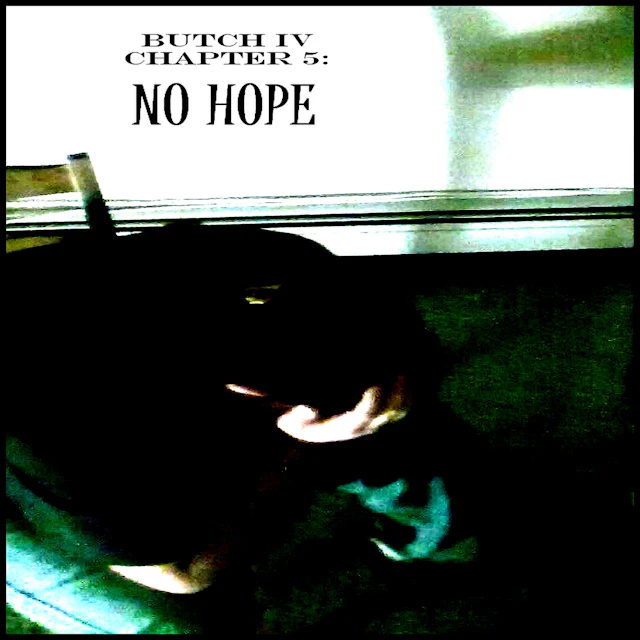
“Chapter 5: No Hope,” the latest album by Butch Against The Machine (Butch IV), stands as a deeply introspective and unguarded body of work, one that rejects polish in favour of emotional immediacy. Conceived and recorded almost entirely in single or double improvisational takes, the album captures the volatile intersection between impulse and expression. Rather than constructing compositions through refinement and technical precision, Butch embraces spontaneity as a philosophical and artistic foundation. This approach lends the record a rare authenticity, where each moment feels less like performance and more like revelation. The absence of meticulous editing or structural correction reinforces the album’s identity as a document of lived emotion, rather than a curated artistic product. In this sense, “Chapter 5: No Hope” functions as a sonic journal—an unfiltered chronicle of an individual attempting to confront and understand internal disorder.
The opening track, “Hazy,” establishes the emotional vocabulary of the album through an atmosphere defined by uncertainty and tonal fragility. Its loose structure and wandering melodic fragments evoke the sensation of consciousness struggling to stabilise itself. This sense of disorientation flows seamlessly into “Burning Tree,” where heavier textures emerge, introducing an undercurrent of agitation and suppressed intensity. The transition between these tracks illustrates Butch’s instinctive ability to navigate emotional extremes without relying on conventional compositional frameworks. “Scourge of Suburbia” expands this tension further, channelling a sense of suffocation through dense instrumentation and restless rhythmic movement. Here, the improvisational method becomes especially powerful, as the unpredictability of the performance mirrors the psychological unrest embedded within the music’s thematic core.
“MCMCXII” and “S.O.L.” mark a shift toward deeper introspection, trading aggression for emotional gravity. These tracks unfold with a sense of deliberate heaviness, as though weighed down by memory and unresolved experience. There is an almost cinematic quality to their progression, where silence and restraint play as critical a role as sound itself. This careful balance demonstrates Butch’s understanding that emotional intensity does not always require volume or speed. Instead, the tension resides in tonal choices and pacing, allowing each note to carry emotional consequence. “Lazy,” despite its deceptively casual title, continues this introspective trajectory, presenting a subdued yet uneasy atmosphere that suggests emotional fatigue rather than relaxation. The improvisational nature of these performances reinforces their sincerity, as the listener becomes aware of the artist’s presence within each spontaneous decision.
The middle section of the album, including “Harvesting” and “Cradle,” introduces a more fragile emotional dimension. These tracks feel less confrontational and more reflective, exploring vulnerability through sparse arrangements and restrained melodic phrasing. There is an unmistakable sense of exposure within these pieces, as though the artist is allowing private emotional states to exist without defence or concealment. “Per Contra” disrupts this quiet introspection with a return to harsher tonal textures, creating a stark emotional contrast that prevents the album from settling into predictability. This unpredictability is central to the album’s identity, reinforcing the improvisational philosophy that governs its creation. Each track exists as a moment of emotional truth rather than a predetermined narrative point.
“Don’t Know” and “Meat Glue” further complicate the album’s emotional landscape, introducing elements of unease and psychological fragmentation. The tonal instability within these tracks reflects an internal environment where clarity remains elusive. These compositions resist resolution, instead embracing ambiguity as a legitimate emotional state. This refusal to provide closure is not a flaw, but rather a defining characteristic of the album’s artistic philosophy. By allowing uncertainty to persist, Butch acknowledges the complexity of emotional experience without imposing artificial order. The listener is not guided toward comfort, but toward confrontation and awareness.
The latter tracks, “Claw” and “Regression,” intensify this sense of confrontation through darker tonal colouration and increasingly aggressive sonic textures. These pieces feel urgent, almost desperate, as though attempting to expel accumulated emotional pressure. The improvisational execution enhances this urgency, preserving the immediacy of the artist’s psychological state at the moment of recording. There is no sense of distance or detachment; the listener is placed directly within the emotional environment from which the music emerged. This immediacy transforms the album into an immersive experience, one that demands active emotional engagement rather than passive listening.
The title track, “No Hope,” serves as the album’s emotional and conceptual culmination. Rather than presenting despair in theatrical or exaggerated form, the track conveys a quieter, more enduring form of emotional exhaustion. Its restrained pacing and minimalistic structure create a sense of finality without resolution. This choice reinforces the album’s commitment to honesty over narrative satisfaction. “No Hope” does not attempt to offer redemption or closure, but acknowledges the persistence of emotional struggle as an ongoing reality. This refusal to conform to conventional expectations underscores the album’s philosophical integrity.

Beyond its individual tracks, “Chapter 5: No Hope” reflects the artistic identity of Butch Against The Machine as a solitary creator shaped by isolation and personal history. His geographical and creative journey, spanning influences from multiple cities and musical traditions, manifests in the album’s stylistic diversity. Elements of heavy rock, metal, country, and classical music coexist without hierarchy, unified by their shared emotional authenticity. This stylistic fluidity reflects Butch’s rejection of genre limitations, allowing emotional necessity rather than stylistic convention to dictate the music’s form. The result is an album that feels deeply personal and stylistically expansive.



Ultimately, “Chapter 5: No Hope” stands as a powerful testament to the expressive potential of improvisation. By abandoning technical perfection in favour of emotional truth, Butch Against The Machine creates a work that feels immediate, human, and uncompromising. The album does not seek validation through accessibility or conventional beauty but invites listeners into a raw and unfiltered emotional space, where vulnerability exists without mediation. In doing so, it affirms music’s capacity to function as emotional documentation and psychological survival. “Chapter 5: No Hope” is an experience to be confronted, endured, and ultimately understood.
Connect with Butch Against The Machine (Butch IV)
WEBSITE
SOUNDCLOUD
BANDCAMP
SPOTIFY
YOUTUBE
INSTAGRAM