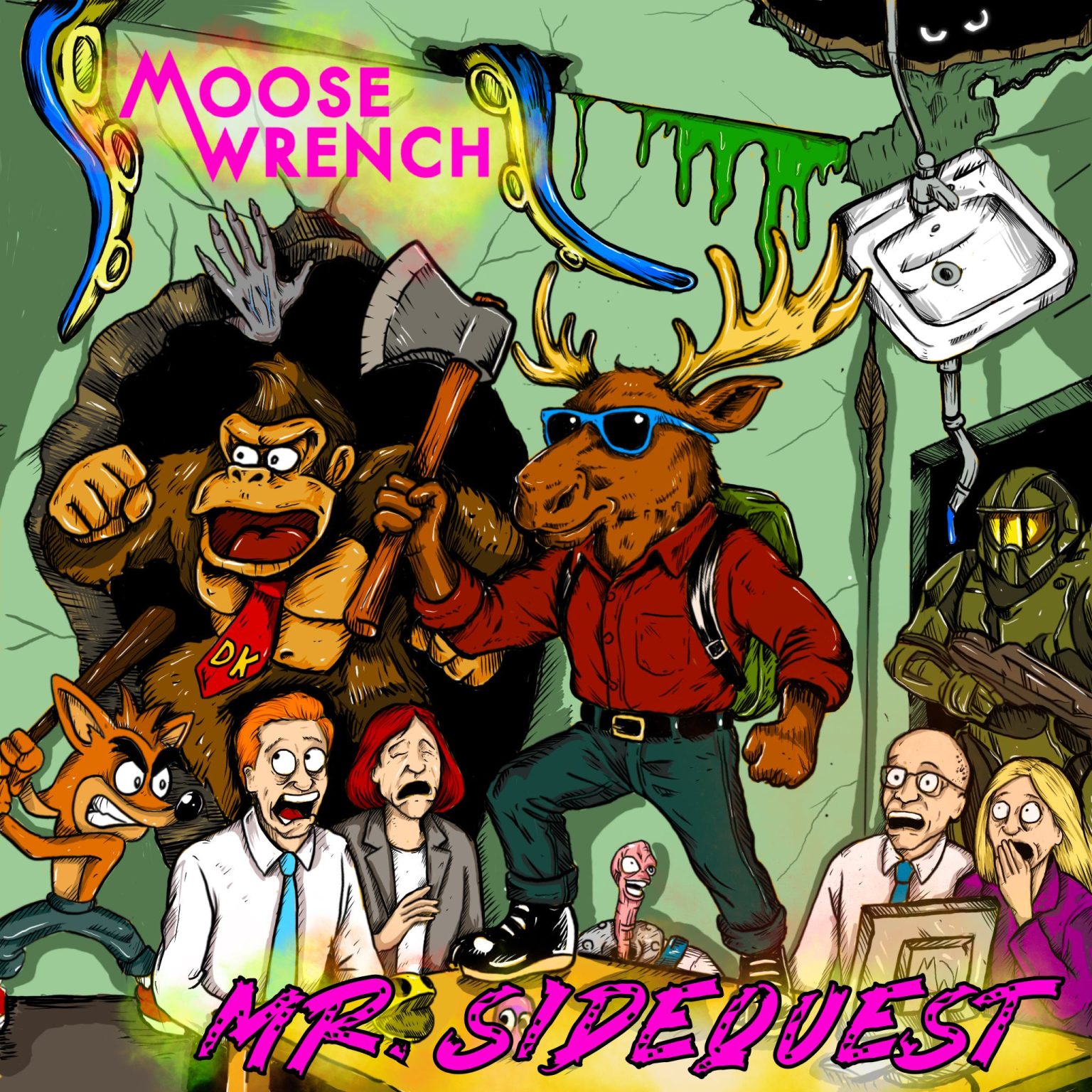
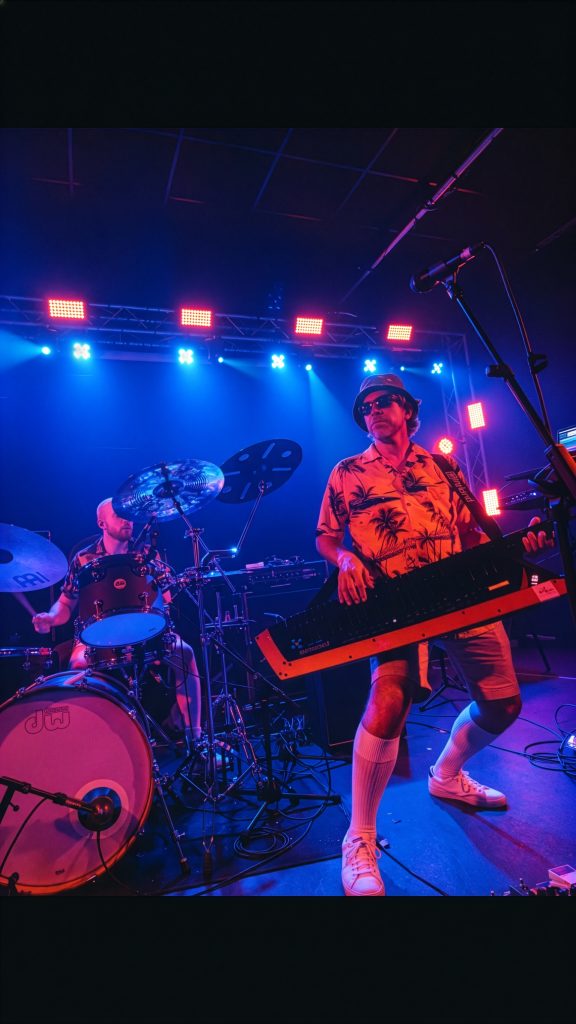
Moose Wrench’s “Dead Stars” doesn’t ease us into its weird, colorful world but throws us headlong into it. In seconds, the Leeds trio conjures a psychedelic maelstrom of energy that’s like walking into a lost festival stage where progressive rock, experimental electronica, reggae grooves, and joyous absurdity are all playing together. It’s an opening that hooks you immediately, because it doesn’t go where you think it’s going. Moose Wrench eschews the traditional guitar-driven alternative rock for a keytar, bass, and drum-driven electrifying sonic landscape that proves imagination is easily the equal of convention. The result is exciting and unpredictable, with moments reminiscent of the psychedelic experimentation of the late ’60s, but with a contemporary edge thanks to its fearless attitude. It’s got the free-spirited chaos of Woodstock, but the personality of the band makes it more than a nostalgic imitation. Every turn is purposeful, every rhythmic aside is inquisitive, and every unexpected musical embellishment reinforces the sense that Moose Wrench lives in its own gloriously eccentric world. By the time “Dead Stars” hits the one-minute mark, it’s abundantly clear the track is music not meant to sit comfortably in the background. It takes engagement, it takes curiosity, it takes a willingness to embrace the wonderfully weird.
Musically, “Dead Stars” is an exhilarating tightrope walk between technical accuracy and gleeful unpredictability. At a sprightly 145 BPM the track pushes ahead restlessly, driven by a lively rhythm section that never quite finds a comfortable groove. The bass grooves are great with lots of elasticity, and the drums are fluid between the driving elements of rock and the subtle rhythmic influences of reggae, creating an infectious, ever-changing pulse. And the secret weapon of the album is the keytar, which provides swirling melodies, kaleidoscopic textures, and deliciously off-kilter flourishes that give the song its unmistakable identity. Moose Wrench’s influences can be seen at times in flashes reminiscent of boundary-pushing acts like The Cardiacs, Mr. Bungle, Primus, and Ween, but the trio never feels derivative. Instead, they take those adventurous spirits and forge them into a sound all their own. There’s something theatrical about this arrangement, as if all the instruments are engaged in some complex dialog, none of them quite knowing where it is going. The production captures this controlled chaos beautifully, giving each instrument enough clarity to show off its individual personality without losing the overwhelming sense of collective momentum. None of these sudden transitions feel random, they feel earned, and each successive listen is more rewarding as you peel back the layers of this dense musical tapestry to reveal the hidden details.
As a lyric, “Dead Stars” is surprisingly restrained for the hugeness of its subject matter. Moose Wrench avoids long, philosophical introspections on man’s position in the universe and instead goes the minimalist route, letting simple words become almost another rhythmic instrument woven into the fabric of the song. It’s a surprisingly effective choice, allowing the music to convey what lengthy lyrical exposition would only dilute. But beneath the playful surface there is a surprisingly deep meditation on existence that reminds the listener that humanity is just a speck in an unimaginably vast cosmos. And so this existential outlook gives the song an unexpected emotional resonance, rooting its psychedelic exuberance in real philosophical contemplation. The experiment with lighthearted music and universal themes creates a nice tension that keeps the experience intellectually interesting without being too heavy. Rather than asking listeners to parse every word, the band asks them to surrender to atmosphere, rhythm, and feeling. It’s hypnotic music, built on repeating grooves and swirling keyboard passages, that slowly pulls the listener deeper into its strange orbit until imagination begins to blur with reality. There is a playful feeling of losing oneself in the performance, as if Moose Wrench has created an alternate dimension where absurdity and enlightenment can co-exist comfortably. And while one is quietly contemplating the cosmic insignificance implied below the surface, it is impossible not to smile at the sheer audacity of the journey.
In the end, “Dead Stars” succeeds because it celebrates uncompromising individuality. What makes Moose Wrench special is that they are especially confident in not shaving off their eccentricities for the sake of wider acceptance but rather fully embracing the progressive absurdism that makes up their artistic identity. There are no guitars, fearless genre-hopping, psychedelic textures, or delightfully unconventional arrangements that add up to make for a listening experience that seems refreshingly original in today’s increasingly formulaic alternative landscape. More importantly, the band never confuses complexity with substance. Each surprising detour points to the larger emotional and philosophical experience, not just to show off technical prowess. Equal parts celebration, hallucination, meditation on existence, and musical prank, “Dead Stars” somehow doesn’t buckle under the weight of its ambition. It’s a track that has you laughing at its sheer weirdness one minute and questioning your place in the universe the next. Not many songs can scratch your head, make you smile widely, and immediately hit replay at once, but Moose Wrench does just that. “Dead Stars” serves as a reminder that there’s space in alt-rock for fearless imagination and that the most gratifying musical journeys are often those that don’t stick to a map.
For more information, follow Moose Wrench
FACEBOOK
SOUNDCLOUD
BANDCAMP
YOUTUBE
INSTAGRAM