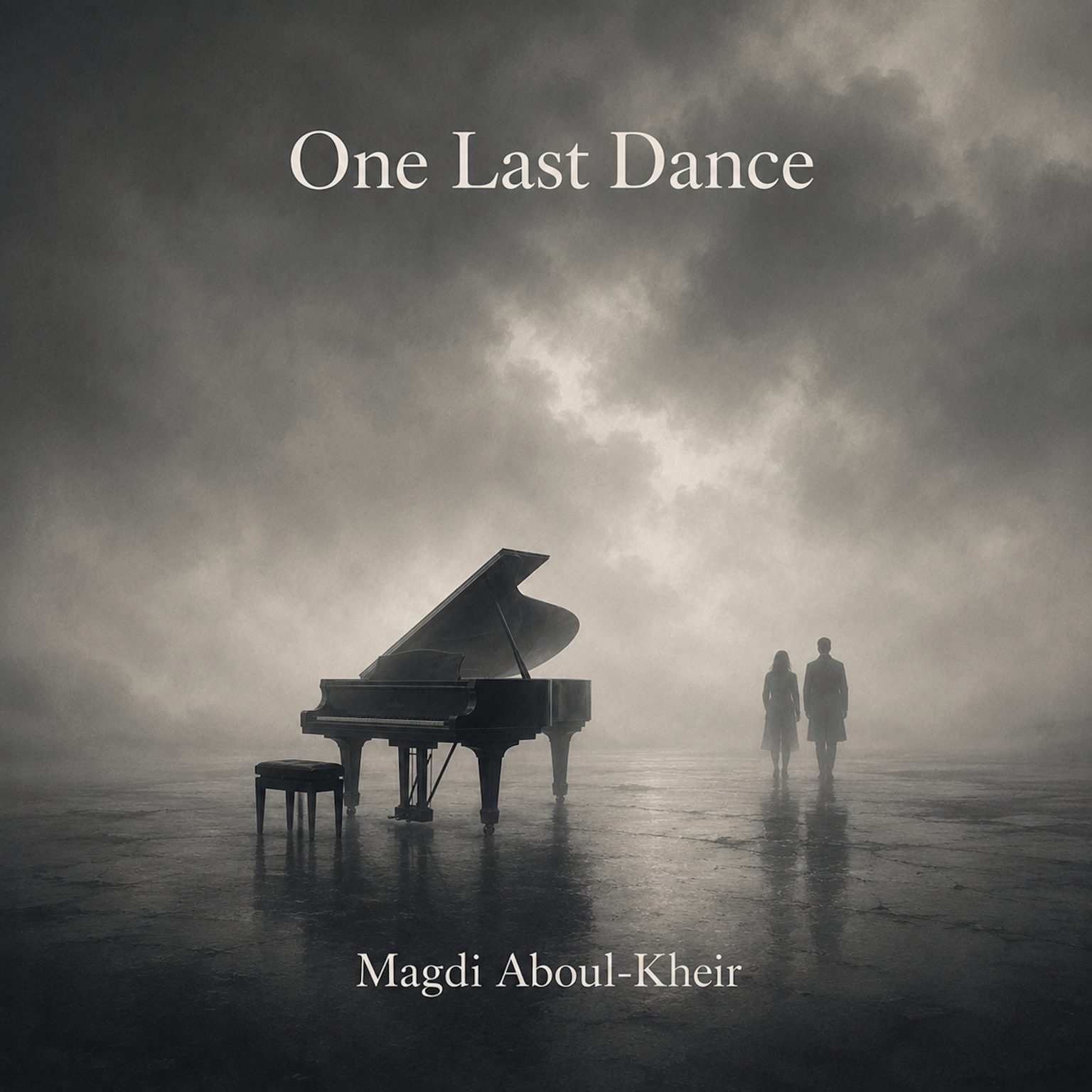
Magdi Aboul-Kheir’s One Last Dance is an album that refuses to dazzle, choosing something more enduring instead: emotional clarity. Fifteen years ago, the German composer created a meditative space in these ten deftly formed piano pieces where melody is more important than virtuosity and silence is as important as sound. This album is not a collection of separate songs but one single story, an inward journey of memory, desire, and gentle resignation. The first few notes make it clear that Aboul-Kheir is less about showing off his technique and more about guiding the listener through what might be called the ‘ballroom of life,’ where each musical phrase is a step in a slow, measured dance between past and present.
The album begins with “From Depth to Depth,” a track that establishes the tonal and emotional vocabulary of the work. The track is a simple motif, which develops slowly, demonstrating Aboul-Kheir’s compositional philosophy: small variations, introduced carefully, are capable of producing profound expressive effects. This is continued in “Carousel of the Mind” and “Veil of Fog,” where repetition is never static but is gently reshaped through subtle shifts in dynamics, register, and harmonic color. The preponderance of stepwise motion over moments of dramatic leaps creates an intimacy, as if the music were happening in real time rather than being imposed upon the listener. Each phrase is organic, almost conversational, bolstering the feeling that these compositions are less about performance, more about communication.
One Last Dance is characterized by following the melody as the main expressive force. While his classical pianistic roots are undeniable, his stylistic reach extends far beyond the classical domain. There are touches of minimalism, ambient music, and even traces of jazz sensibility that creep into the fabric of the album, but they never cloud its central identity. Songs such as “Calliope’s Embrace” and “Two Sides of Tomorrow” illustrate how lyrical phrasing can be used to create emotional power without being complicated. The right hand often assumes a vocal quality, with lines that appear to breathe naturally, as the left hand offers a stable harmonic base with open chords and softly flowing arpeggios. It’s a balance that stays rooted in music, but with a sense of openness and expansiveness.
Also remarkable is the restraint of the album’s harmonic language. Aboul-Kheir does not go for dramatic modulations or surprising tonal shifts but rather a more judicious approach, favoring tonal clarity with occasional modal inflections. Sometimes chords have added tones or subtle inversions that add warmth without drawing attention to themselves. There are many suspensions, delayed resolutions, and little moments of soft tension that almost imperceptibly fade away. That harmonic subtlety is particularly apparent in pieces such as “A Quiet Yes” and “When Smiles Return,” reflecting the emotional themes of hesitation, acceptance, and renewal. The music is not attention-seeking, but rather attention-giving, inviting the listener to engage as they wish.
Rhythm is also a crucial, if understated, element throughout the album. The majority of the tracks are at a fairly constant pace, but the feeling of movement comes from the phrasing, not the rhythmic complexity. This creates an effect of spontaneity, as if the piece were being revealed rather than performed. One example is “Enchanted by Your Light,” with its flowing tempo and mild balance of melody and accompaniment. Without the constraints of rigid rhythmic structures, the music has more freedom, which contributes to the album’s contemplative mood. It’s a small but important choice, one that speaks to Aboul-Kheir’s commitment to emotional truth over structural constraint.
The sense of cohesion becomes even more striking as the album draws to the title track, “One Last Dance.” This is the reflective and culminating piece, pulling together the thematic threads woven earlier in the album. The melody sounds familiar, like an echo of motifs we’ve heard before, but also brings in new nuances that speak of growth and transformation. It’s quietly poignant in its phrasing, recognizing the end without finality or abruptness. There is something that continues, as if the music has faded, yet the dance persists. It is a pause, a pause that lingers long after the last note has been struck.

“Afterthoughts,” the album’s closing track, is a soft epilogue of reflection and not resolution. The subtlety is typical of the prevailing philosophy of the album: that meaning is often in the unspoken. Aboul-Kheir’s use of silence is particularly striking here, the pauses seeming purposeful rather than idle. These are moments for the listener to process the emotional arc of the album, and listening becomes a kind of self-reflection. That is a fitting end, not summing up but remaining, leaving traces of its presence in the listener’s memory.
Ultimately, One Last Dance is a tribute to the strength of restraint in musical expression. At a time when complexity is too often mistaken for depth, Magdi Aboul-Kheir makes a compelling case that simplicity, if approached consciously and reflectively, can be just as significant. The album’s power lies not in technical demands but in composed melodies, subtle harmonies, and a real sense of pacing that evokes real emotion. It’s a track that repays close listening, revealing more on each play. More than that, it’s a reminder that music needn’t be grand to be meaningful, only honest.


Connect with Magdi Aboul-Kheir
FACEBOOK
SPOTIFY
SOUNDCLOUD
BANDCAMP
INSTAGRAM