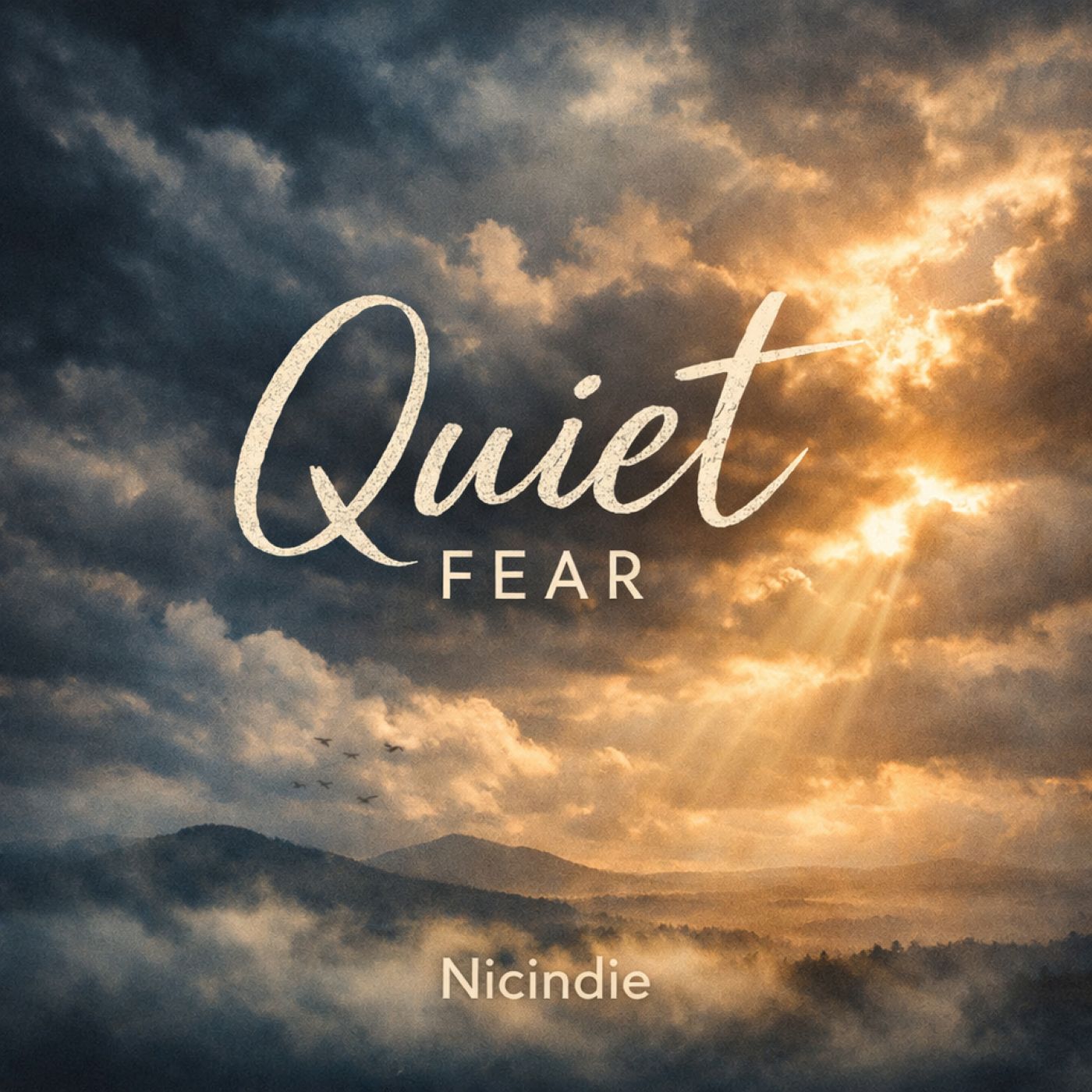
Anxiety rarely enters a room with a crash. More often, it slips through the smallest opening—a restless thought before sunrise, a breath held for too long, an invitation quietly declined, or the sudden realization that even the simplest task feels strangely enormous. Nicindie’s “Quiet Fear” understands that particular kind of emotional weather with remarkable precision, turning the subdued experience of anxiety into a song that is intimate, atmospheric, and quietly devastating. Rather than treating fear as something theatrical, the track focuses on the ordinary ways it can reshape a life: mornings that begin exhausted, plans that disappear before they happen, conversations postponed because honesty feels too difficult, and relationships gradually pushed further away because retreat seems safer than explanation. There is a refreshing lack of melodrama in the writing. Nicindie does not attempt to inflate the emotion into something grander than it is; instead, the song finds its power in the uncomfortable familiarity of small moments. That restraint gives “Quiet Fear” an unusually believable emotional center. It feels less like someone performing anxiety for an audience and more like being allowed briefly inside somebody’s private thoughts. The song’s atmosphere is appropriately hushed, creating the impression of an internal world where everything is happening just beneath the surface. Even the title captures its central contradiction: the fear is powerful but quiet, invisible yet capable of altering entire days. That makes the track particularly effective because anxiety is often misunderstood precisely because it can look like nothing is happening. From the outside, someone may simply appear drained, distant, unavailable, or uninterested. Inside, however, an exhausting battle may be unfolding. “Quiet Fear” gives that invisible struggle a sonic shape without turning it into spectacle.
One of the most fascinating artistic choices is Nicindie’s use of an AI-generated voice, because the technology becomes much more than a production novelty. In another song, a synthetic voice might simply be an experimental flourish, but here its subtle emotional distance becomes perfectly suited to the subject matter. The voice seems to hover slightly outside the listener’s reach, creating the sensation of hearing someone speak through glass or from behind a closed door. There is something almost uncanny about that separation, and it works because anxiety itself can create a similar disconnect between what a person feels and what they are able to communicate. You can know exactly what is happening inside you and still struggle to make those feelings understandable to someone else. By using a generated vocal to embody that distance, Nicindie effectively makes technology part of the storytelling. The synthetic quality does not undermine the song’s humanity; surprisingly, it makes the humanity more apparent. The listener becomes conscious of the gap between a voice and the person supposedly behind it, mirroring the emotional gap anxiety can create between an individual and the people around them. This gives “Quiet Fear” a distinctive identity within contemporary independent music. Instead of using AI simply because it is fashionable, Nicindie integrates it conceptually, making the sound itself reflect the psychological subject. The vocal does not need to belt or strain to convey distress. Its restraint becomes its strength. Against the understated production, every phrase feels like something cautiously admitted rather than confidently announced. That approach also complements the song’s lyrical perspective, which avoids explaining anxiety in clinical or overly literal terms. Instead, the emotional truth emerges through the accumulation of everyday details. The result is an inner monologue that feels suspended somewhere between thought and speech, as though the listener has stumbled upon a private confession that was never quite intended to be overheard.
Structurally, “Quiet Fear” is equally effective because it refuses the conventional temptation to turn emotional struggle into a significant cathartic payoff. The song follows a quieter progression, moving from isolation toward the fear of honesty and eventually toward the possibility that allowing another person into that private world might make the burden slightly easier to carry. It is an understated form of hope, and that makes it believable. Anxiety rarely disappears because of one dramatic realization, and recovery is seldom a perfectly ascending line toward happiness. More often, progress consists of tiny decisions: answering a message instead of ignoring it, admitting that something is wrong, accepting an invitation, asking for company, or simply choosing not to retreat when retreat feels easier. Nicindie captures that reality by allowing the emotional temperature to change gradually. There is no need for a giant instrumental explosion to announce that hope has arrived. Instead, the possibility of connection becomes meaningful precisely because it remains fragile. The accompanying lyric video reportedly extends this same reflective approach, carrying the story from isolation toward the hope of letting someone in. That visual philosophy feels perfectly matched to the music because “Quiet Fear” is ultimately concerned with the things people do not say. Anxiety thrives in silence, in assumptions, and in the stories we construct privately because speaking them aloud feels too vulnerable. A visual treatment that resists over-explaining therefore makes sense, leaving room for the audience to supply their memories and interpretations. This restraint also strengthens the track’s sense of universality. Nicindie may have written from personal experience, but the song does not trap that experience inside a single biography. Instead, it leaves enough space for listeners to recognize their moments of withdrawal, uncertainty, loneliness, or apprehension. The music becomes a mirror rather than a lecture, and that is one of its greatest accomplishments.

Ultimately, “Quiet Fear” is powerful because it understands that recognition can sometimes be more meaningful than resolution. Nicindie does not promise that the final note will neatly defeat anxiety, nor does the song pretend that vulnerability automatically fixes everything. Instead, it offers something quieter and arguably more valuable: the reassurance that someone else understands what it feels like to carry an invisible weight. The track’s small scale is part of its strength. Its synthetic vocal, understated atmosphere, patient structure, and carefully controlled emotional progression all contribute to a piece that feels remarkably honest about both its subject and its construction. There is courage in making a song about fear that does not make it sound glamorous. There is also courage in acknowledging that the first step toward healing may simply be allowing someone else to see what is happening. That idea gives “Quiet Fear” its final emotional lift. The song begins in isolation, where ordinary life feels heavier than it should, but gradually opens a door toward connection. It does not fling that door wide open; it merely leaves it unlocked. That distinction feels important. For anyone who has ever cancelled plans because going out felt impossible, withdrawn from someone they cared about because explaining themselves seemed exhausting, or woken up already overwhelmed without knowing exactly why, the track offers a deeply recognizable emotional language. It says, in effect, that the fear does not have to remain entirely private. And perhaps that is why the song lingers. It does not shout for attention, demand sympathy, or manufacture a dramatic resolution but simply sits beside the listener and acknowledges the weight. In doing so, Nicindie turns a deeply personal experience into a quietly communal piece of songwriting—one that reminds us that sometimes the most important musical gesture is not telling someone everything will be fine but letting them know they do not have to carry the silence alone.