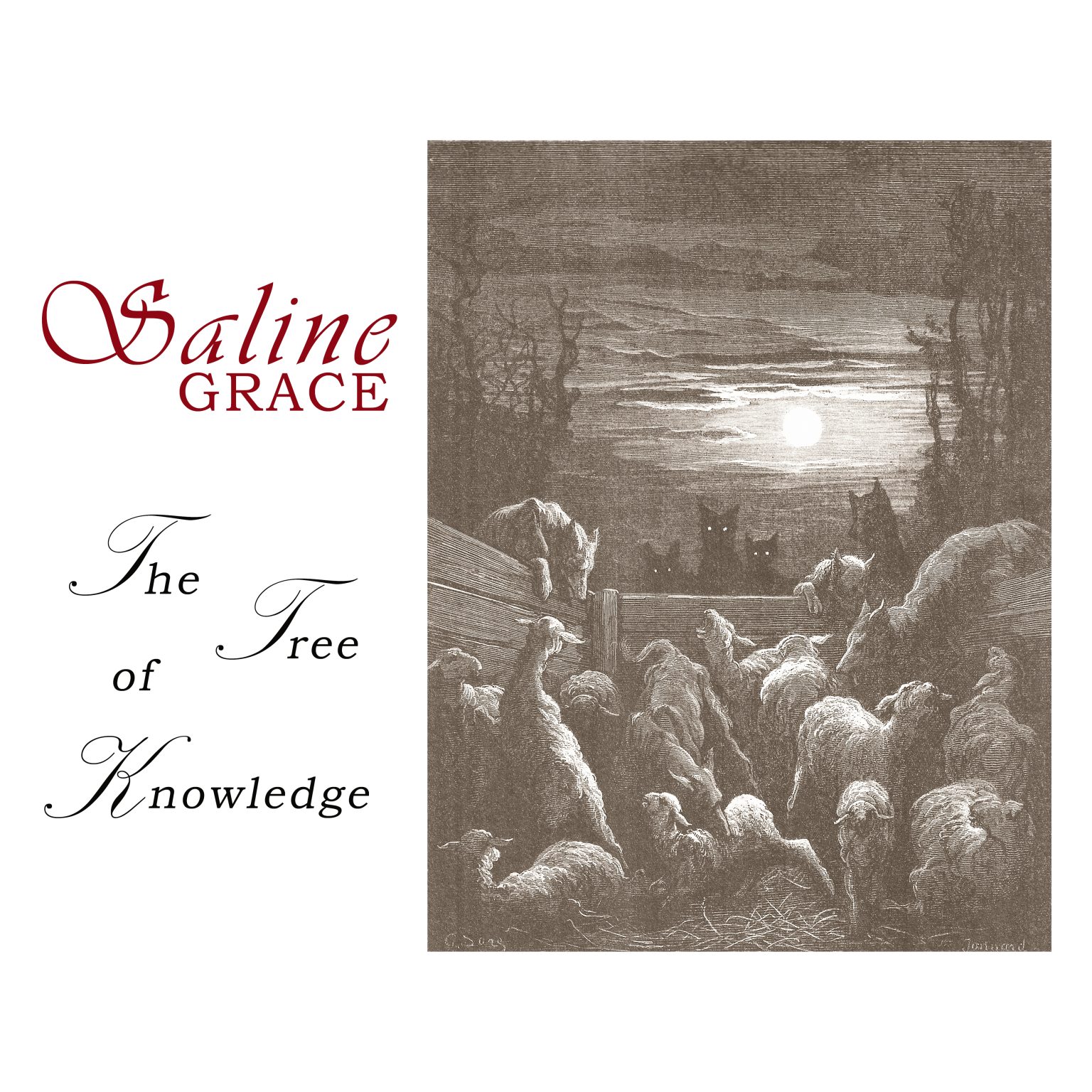
There is something quietly radical about an album that refuses to conform, and The Tree of Knowledge by Saline Grace stands firmly in that territory. In an age where algorithms often flatten musical discovery into predictable loops, this record arrives as a deliberate, almost defiant statement of artistic depth. Crafted by Riccardo and Ines Hoffmann, the album is a carefully constructed journey through mood, texture, and emotional resonance. From its opening moments, it becomes evident that this is a work shaped by intention rather than trend, one that leans heavily on atmosphere while never sacrificing melodic or structural clarity.
The title track, “The Tree of Knowledge,” serves as an evocative gateway into the album’s world. Saline Grace draws heavily from goth and post-punk traditions here, weaving baritone vocal lines through layers of shimmering guitars and subtle synth arrangements. The result is familiar and refreshingly distinct, as if the band is acknowledging its influences while quietly reshaping them. There is a sense of invitation embedded in the track—a call to step into an environment where sound behaves like memory, shifting and expanding with each listen. It is an opening that sets expectations high, only for the album to surpass them in increasingly imaginative ways.
“Lethal Anaconda” follows with a hypnotic intensity that underscores the duo’s ability to command attention through repetition and texture. The instrumentation coils and uncoils with deliberate patience, creating a sonic grip that lingers well beyond the track’s runtime. By contrast, “Raven Berta” moves into more cinematic territory, emphasising layered soundscapes that feel almost visual in their construction. Saline Grace demonstrates remarkable versatility here, proving that their strengths extend beyond conventional song structures into something more atmospheric and exploratory. This interplay between immediacy and abstraction becomes one of the album’s defining traits.
The transition into “Individual Case” and “Autumn Realms” further highlights the band’s nuanced approach to genre fusion. The former leans into a brooding, goth-inflected ambience, driven by warm basslines and angular guitar work that gradually builds into a steady rhythmic presence. The latter, however, introduces elements of folk rock, complete with mandolin textures and a subtly propulsive rhythm section. What makes these shifts compelling is not merely their diversity, but the seamlessness with which they are executed. Saline Grace treats genre as a palette rather than a boundary, selecting elements with precision and integrating them in ways that feel organic rather than ornamental.
Midway through the album, “The Descent” and “Rooms to Let” stand as testaments to the duo’s songwriting maturity. These tracks reveal a deeper emotional core, where lyrical delivery and instrumental arrangement operate in near-perfect alignment. There is a fluidity to the way melodies unfold, supported by sonic details that seem to move with an almost narrative intent. Each note feels placed with care, each transition guided by an understanding of how tension and release can shape listener experience. It is here that the album’s conceptual weight becomes most apparent, suggesting a thematic undercurrent that ties its diverse elements together.
“Grapes” and “Bloody Tears” continue this trajectory, offering moments of accessibility and introspection. The former benefits from the interplay between Riccardo Hoffmann’s baritone vocals and Ines Hoffmann’s ethereal backing layers, creating a dynamic that is as engaging as it is emotionally textured. The latter leans more heavily into goth and post-punk influences, unfolding with a deliberate pacing that mirrors the arc of a well-told story. Saline Grace excels in crafting atmospheres that evolve rather than simply exist, allowing each track to feel like a distinct chapter within a larger narrative.
“Skagerrak” introduces a different kind of expansiveness, drawing on darker, almost medieval tonalities enhanced by subtle world music influences. The track carries a cinematic weight that makes it feel as though it belongs as much to visual storytelling as it does to the album itself. This sense of scale is balanced by the closing pieces, “Memories of Winter #2” and “Weeping Wounds,” which return to a more intimate, goth rock foundation. These final tracks do not merely conclude the album—they distil its essence, offering a reflective space in which its themes can settle and resonate.

One of the most striking aspects of The Tree of Knowledge is its restraint. Despite drawing from a wide array of influences—alternative rock, goth, post-punk, darkwave, folk, and beyond—Saline Grace never allows these elements to overwhelm the core identity of the music. Instead, they function as subtle enhancements, carefully deployed to enrich rather than dominate. This approach speaks to a level of craftsmanship that is increasingly rare, where the focus remains firmly on serving the song rather than showcasing technical ability for its own sake.


Ultimately, The Tree of Knowledge stands as a compelling argument for the enduring power of thoughtful, deliberate artistry in contemporary music. Saline Grace has created an album that rewards patience and attentive listening, offering new details with each revisit. It is a work that resists easy categorisation, not out of defiance but out of necessity, as its identity is built upon the careful blending of disparate elements into a cohesive whole. For listeners willing to engage with its depth, the album offers an experience that is intellectually stimulating and emotionally resonant—a rare balance that ensures its place among the more memorable releases in modern alternative rock.
Connect with Saline Grace
WEBSITE
FACEBOOK
SPOTIFY
INSTAGRAM
YOUTUBE