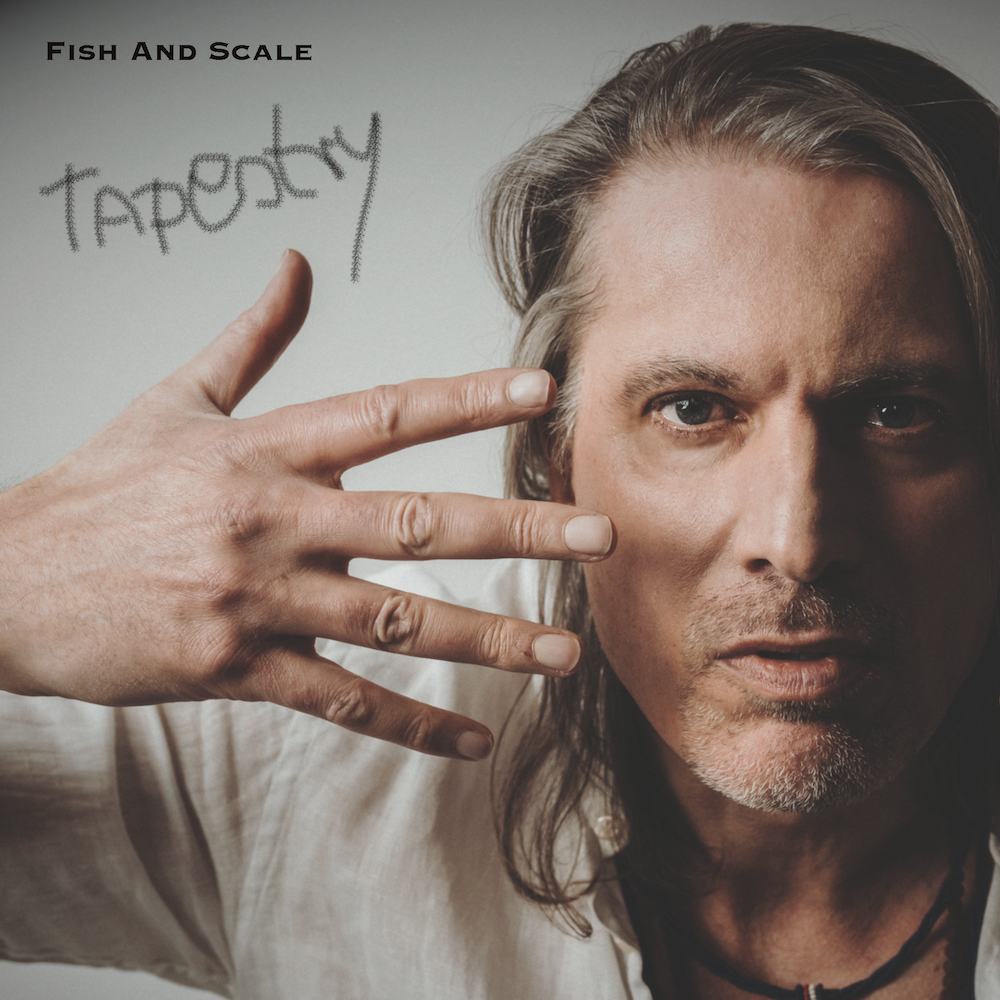
In “Tapestry,” Fish And Scale offers a composition that feels less like a conventional song and more like an unfolding inner landscape. Known for his deeply introspective and spiritually inclined approach to independent folk, Roland Wälzlein crafts a piece that invites listeners into a space where memory, emotion, and symbolism intertwine. From the opening lines, there is a sense of quiet unease—rain falling “into the heart” and fragments of the past clouding perception—setting the stage for a narrative that is as psychological as it is poetic. Rather than guiding the listener through a linear story, “Tapestry” operates through impressions, allowing images and emotions to surface gradually, much like recollections emerging from the subconscious. This deliberate ambiguity becomes one of the track’s defining strengths, encouraging personal interpretation and emotional engagement.
Musically, the track reflects Wälzlein’s signature balance between restraint and intensity. The arrangement is understated, allowing his voice—textured, slightly smoky, and undeniably expressive—to carry the emotional weight of the composition. There is a rawness in his delivery that recalls classic rock sensibilities while remaining firmly rooted in a modern, folk-inspired framework. The instrumentation, though minimal, is carefully layered to create atmosphere rather than spectacle. Gentle guitar lines and subtle tonal shifts act as a backdrop for the vocal performance, giving the song a meditative quality. This approach aligns with the artist’s broader philosophy: music not as mere entertainment, but as a conduit for reflection and inner awareness. The unconventional structure further enhances this effect, resisting predictable patterns in favour of a more fluid, almost dreamlike progression.
Lyrically, “Tapestry” is rich with evocative imagery that oscillates between vulnerability and surrealism. Lines referencing “long corridors” and figures in “white robes” introduce a clinical, almost haunting environment, while the recurring longing for connection grounds the song in deeply human emotion. Perhaps the most striking image—the “tiny yellow dog on the wallpaper”—serves as a symbol of fragile hope, a small but significant detail from which the narrator draws strength. This juxtaposition of fear and comfort, isolation and yearning, gives the song its emotional complexity. The repeated question of worthiness—“Am I good enough, am I worthy?”—resonates as a universal concern, elevating the track beyond its abstract imagery into something profoundly relatable. It is a song about searching—for reassurance, for connection, and ultimately, for meaning within one’s own experiences.
What sets “Tapestry” apart is its ability to linger in the mind long after it ends. It embraces uncertainty as part of its artistic identity. In doing so, Fish And Scale creates a listening experience that feels deeply personal yet widely accessible. The track becomes a mirror, reflecting the listener’s own thoughts and emotions to them in subtle, unexpected ways. As part of Wälzlein’s broader body of work, “Tapestry” reinforces his reputation as an artist unafraid to explore the more introspective and enigmatic corners of human experience. It is a quiet yet powerful reminder that music, at its most effective, invites us to discover our own within its layers.
Connect with FISH AND SCALE
WEBSITE
FACEBOOK
SPOTIFY
YOUTUBE
INSTAGRAM