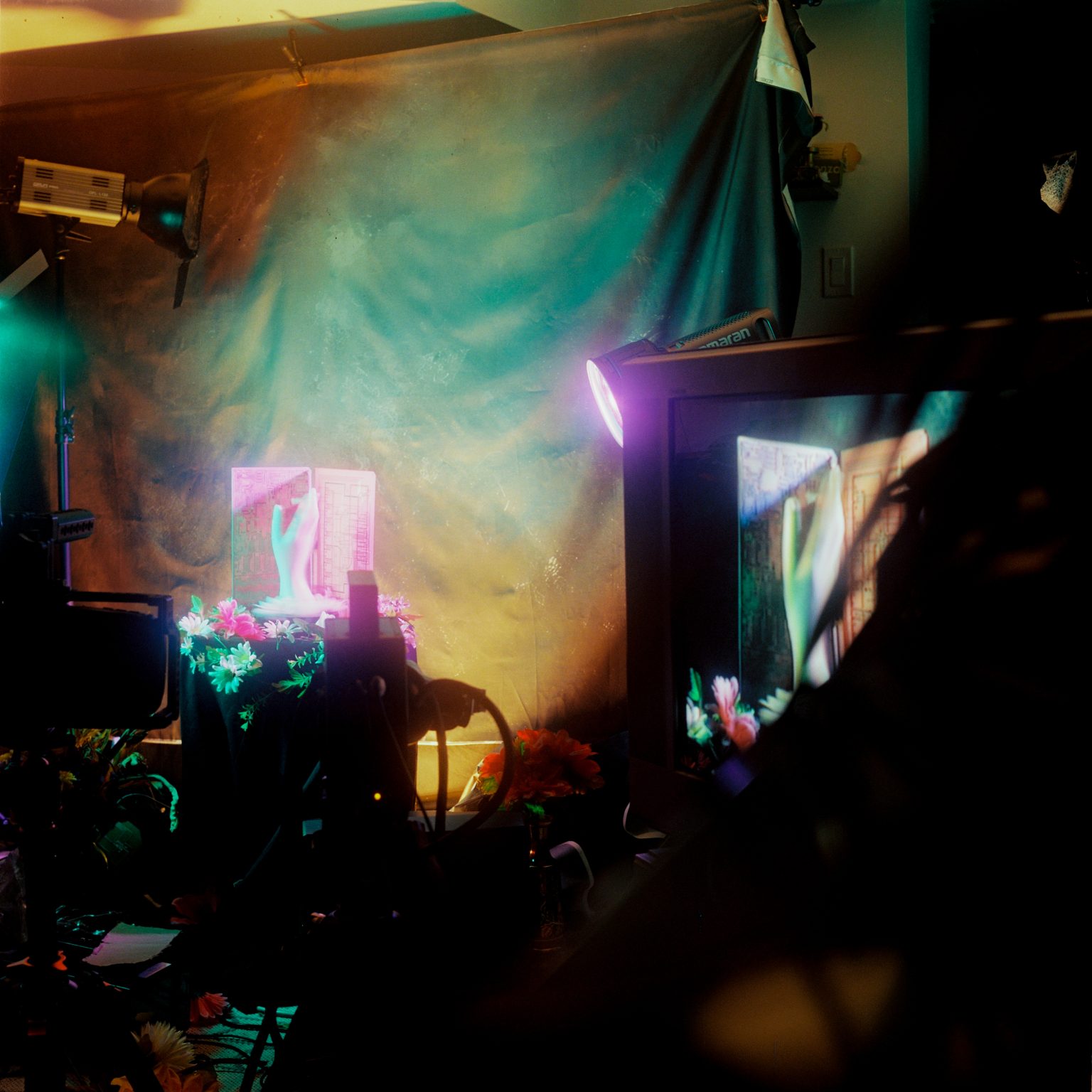
Hyperflower’s self-titled debut EP is a brilliant meditation on connection, distance, and the invisible forces that shape human experience. The duo of Lorenzo Setti (ATŌMI) and Irene Cavazzoni Pederzini creates a body of work that defies categorization, somewhere between experimental electronic music, ambient composition, and art-pop minimalism. It is clear from the first moments that Hyperflower is a deliberately crafted sonic continuum. All the songs segue into each other with a purposeful subtlety that creates an immersive experience for the patient and attentive listener. The result is an EP, less of a playlist and more of an unfolding emotional landscape.
The opener “Fold” sets the mood with a delicate dance of fractured rhythms and ambient textures. Production is intentionally subdued to allow for participation in the composition. Irene’s vocals are treated but intimate, a distant signal over the instrumental bed. Within the same sonic frame, there is a sense of duality, of closeness and distance. This ambivalence is typical of the EP, as Hyperflower explores the delicate line between presence and absence. The track seeks to suspend the listener, where meaning is experienced rather than defined.
The EP goes into ‘Tight’ and ‘Hold,’ and the sonic palette expands, but it still has that core sense of introspection. The rhythmic structures of ‘Tight’ are more explicit, yet they remain broken up and erratic, mirroring the fragile nature of emotional connection. The mix sparkles with a few distortions, as if hinting at a universe in perpetual motion. But it’s more melodic and clear, with short touches of warmth within the ambiguity. The interaction between these tracks demonstrates the duo’s ability to balance abstraction and accessibility. The music, even at its most experimental, keeps an emotional tether, so you feel engaged rather than estranged.
The EP’s conceptual and emotional anchor is “Hyperflower,” the title track. Here, the pair indulge their obsession with the confluence of science, philosophy, and human feeling. The piece is layered, with patterns repeating and gradually evolving. It is as if the music were being dictated by its own inner logic and its unfolding were inevitable. The vocals are the focus and an extension of what surrounds them, through the use of clarity and distortion. This dual role also mirrors the central theme of the EP: the idea that identity and environment are interconnected, constantly changing each other, and in constant change. “Gravity” and “Proximity” continue this exploration, employing metaphorical language to explore the forces that draw people together and push them apart. The title, “Gravity,” refers to the emotional gravity of the piece, suggested by low-frequency tones, as if to suggest weight and inevitability. It’s a grounding, spacious track, as if it’s being played by some invisible force. “Proximity” plays with spatial perception, layers shifting, loops evolving, movement conjured from stillness. The use of production techniques to manipulate distance and depth shows a sophisticated understanding of sound design as a narrative tool.
The EP finishes with the last song, “Hyperlapse,” plunging the listener headfirst into the full sonic universe of Hyperflower. The track is the culmination and reflection of the themes and motifs explored throughout the record. Its structure feels accelerated, as if time is being compressed and expanded at the same time. This fluidity of time also reinforces the larger conceptual frame of the EP, where linearity is replaced by cyclical transformation. And the last moments dissolve into uncertainty instead of a definite end, leaving the listener dangling in the same unresolved area where the journey began.
What sets Hyperflower apart from many recent electronic releases is that it’s cohesive and conceptual. Every rhythmic, melodic, or textural element has a bigger purpose in the overall narrative of the EP. The slow evolution, repetition, and distortion are not merely stylistic devices but reflect the themes of memory, transformation, and the elusive nature of human connection. The infusion of mathematical and philosophical concepts also deepens the listening experience, adding layers of meaning that extend beyond the immediate sonic surface. And yet, despite its intellectual foundations, the EP never feels removed or too cerebral. Its emotional pull remains paramount, grounding its more abstract elements in lived experience.
The production duo is equally impressive, seamlessly blending precision with organic unpredictability. The sound design is meticulous; every texture has been sculpted to find its own space in the mix. But there’s an ease that keeps the music from feeling stiff or too buttoned-up. This balance allows the EP to breathe, each track feeling as if it is moving and developing. That tension between sparse moments and moments of thick saturation results in a dynamic listening experience, always oscillating between intimacy and expansiveness. These contrasts reveal the real power of Hyperflower’s artistry.

Ultimately, Hyperflower boldly introduces a sprawling, personal project. It goes against the grain of traditional ideas of song form and genre, providing a complete experience of the amalgamation of music, art, and philosophy into one. The EP invites listeners to absorb it on many levels, whether through the intricate sound design, the concept behind it, or the emotional depth. And in that, it is a rare combination: intellectually stimulating and deeply moving. Hyperflower has made a debut that you must hear and experience. It’s an evocative, immersive record that lingers long after the last note fades into silence.