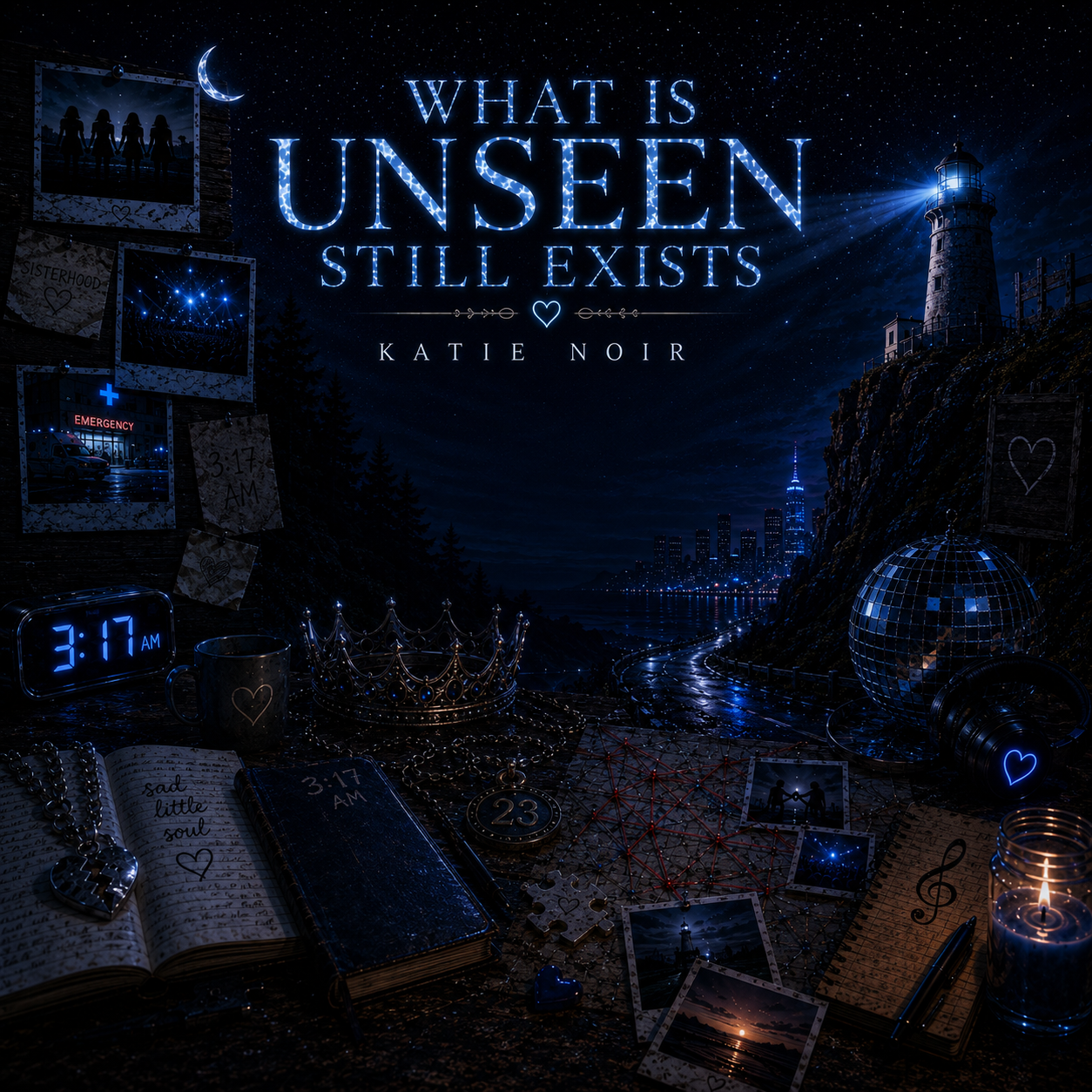
Katie Noir’s debut LP, What Is Unseen Still Exists, is the kind of album that won’t behave like a debut. It’s sprawling and ambitious, intimate and playful, vulnerable and occasionally chaotic, with 23 tracks that ultimately cohere around a remarkably clear artistic philosophy: that the most important parts of our lives are often the parts no one else can see. Invisible experiences, such as feelings, memories, private fears, friendships, regrets, hopes, loneliness, identity crises, and fleeting moments of joy—all of these make up who we are even if they leave no obvious mark on the outside. For Katie Noir, music is the place where those hidden experiences finally become visible. It’s already a formidable creative endeavor for a 21-year-old student to transform thoughts, memories, observations, and personal experiences into an album of this magnitude, but what makes What Is Unseen Still Exists especially intriguing is its resistance to being confined to a single genre or emotional register. Alternative pop meets electronic music, R&B, hip-hop, dance music, synth-pop, lo-fi textures, cinematic composition, and spoken-word storytelling, often within the same conceptual universe. The result feels less like a traditional collection of songs and more like stepping into someone’s inner world and through its various rooms. One track can have you dancing, another can make you confront loneliness, another can make you laugh at the absurdity of modern life, and yet another can suddenly stop you in your tracks with a tender observation. That range of emotion is the album’s greatest strength. Katie doesn’t pretend that a human being can feel only one feeling at a time. We can be hopeful in the morning, anxious at noon, nostalgic in the afternoon, heartbroken at night, and hopeful again before sunrise. What Is Unseen Still Exists embraces this inconsistency and turns it into a structure. Instead of reducing life to one mood, Katie makes the album feel like life itself: unpredictable, contradictory, funny, painful, restless, beautiful, and ever-changing.
The journey begins with the intro “Bitches Road,” which immediately establishes Katie Noir as an artist who will not be coming in quietly. The attitude of the song is almost confrontational, and the repeated sentiment that “everybody talks too much” is a declaration of independence and a warning that this album will not be too concerned with politeness. Her delivery is clipped and commanding, the propulsive bassline rolling underneath the track with muscle, driving her vocal performance. But the opener becomes more than just a statement of confidence in the way Katie can move between a rhythmic, almost rap-like delivery and brighter melodic passages where her voice suddenly opens up. That contrast is an early sign of the versatility that will characterize the rest of the album. Then comes “Soft Again (Don’t Quote Me On That),” and the shift is shocking. A bright, almost morning-like synth-pop arrangement shines with an upbeat feel, while a steady beat gives the song an irresistible sense of motion. But beneath the danceable surface, Katie investigates something much more complicated: the scary experience of being vulnerable again after choosing that vulnerability is dangerous. The character at the center of the song wants connection but is afraid to be soft enough to be hurt. Funny to think about maybe texting an ex again, but under the humor is the achingly familiar tension between wanting and self-preservation. Katie’s vocals capture it all, moving from breathy vulnerability to bursts of strength, from rapid-fire phrasing to soulful melodic delivery. It is one of the album’s clearest examples of Katie making emotional contradiction sound exciting. “Soft Again” makes vulnerability dance.
If “Soft Again” is the seductive side of emotional openness, “MCS” plunges into the frantic machinery of an overactive mind. The industrial synths and digital static instantly induce a sense of midnight mental overload, as if the listener has been dropped into a room where all thoughts are arriving simultaneously. Sharp vocal chops and relentless electronic beats make for a near-breathless momentum, while the character’s insistence that she might look like an NPC but is actually the main character lends the song an irreverent streak of self-awareness. Katie is at her most electronically aggressive, using production as a psychological environment rather than just a backdrop. “Only Us” then raises the temperature, starting with an ambient keyboard pad that gradually approaches like an incoming tide. The song deals with emotional dependency and the temptation to devote a whole future to one person. The main character wants to enjoy the moment and live in the now in the relationship instead of constantly worrying about what the future will bring. Katie’s vocals are intimate and confessional, and it feels as if she is whispering directly to the listener. Then “Out of Touch” draws the listener into one of the more melancholy spaces on the album. An isolated synth and minimal piano create a vast, cold feeling of emotional distance. A ticking clock marks the passing of time. The song is about the experience of someone you used to know well becoming a kind of digital ghost, a person whose life you can still see but with whom you no longer have any real connection. Katie’s comments on how people obsessively comment on other people’s lives provide a modern touch of humor to the sadness, especially the memorable bit with food that becomes cold because someone spends too much time producing content about it. That detail is especially striking because it is so painfully recognizable. For Katie, modern absurdity is another way of talking about emotional disconnection.
The album opens with “Shake That Ass,” a loud, bass-heavy tribute to bodily freedom and self-confidence. Its rough sub-bass and high-spirited synth line are meant to move the listener, but the song has more purpose than its provocative title might initially lead you to believe. Katie employs humor, rhythm, and hyperbole to ridicule superficial judgment and praise the simple joy of inhabiting one’s body without apology. This is the kind of track that can quickly transform a bedroom into a dance floor. This physical energy only makes the following ‘L.I.S.A.’ even more dramatic. A pen scratching on paper introduces the song before a dark looping piano takes over, creating the impression that someone is opening a private diary. The song features someone in her heart even when she is in a difficult emotional state, and the layered vocals suggest multiple versions of the self competing for attention. It’s spooky, but not too stagey. Then ‘Hey Sara’ shines in like sunlight through an open window. The intimate ukulele and ambient room sounds immediately create a sense of warmth, trust, and friendship. This is one of the album’s most sincere moments of affection, a tribute to platonic connection and to the friends who can save us when our minds become dangerous places to be. The diary-like delivery makes the song feel like a private letter to someone she really cares about. “Lexi Waited Anyway” continues that emotional thread, bringing in another friendship that has clearly had a giant impact. The track opens with a long synth that sounds like a telephone dial tone before the drums kick in and set a steady march. It’s all about tension and release, as Katie reminisces on Lexi and the impact she had on her life. Whether the absence is literal or figurative, the emotional truth is the same: some people continue to influence us even after they are gone. Together, these songs show one of the album’s key themes: friendship can be as transformative as romance.
“The Sisterhood” takes that idea of connection and makes it something collective. The track sounds like a declaration of solidarity, with militant marching percussion and triumphant synth-brass chords. Katie celebrates women who watch each other’s backs, who stand together, who say no to toxic behavior dictating their relationships or their sense of self. Importantly, the song is not an easy attack; it is framed around the emotional center of empowerment and mutual defense. Katie’s impassioned vocal delivery makes it feel like an anthem made for a crowd to shout back at. Then the album’s conceptual centerpiece, “What Is Unseen Still Exists,” distills the entire record’s philosophy into one haunting musical statement. It starts with spooky mouth percussion and a big piano chord, and it sounds like opening a door to a room that has been shut off for years. The track is about unseen struggles, private hopes, and the better world that exists first in the imagination before it can become reality. Its main message—that something can be postponed and not denied—is perfectly suited to an album about unseen emotional realities. Musically, the track develops from fragility to a massive wall of sound, making the private monumental. The climax is where the many individual stories of the album come together as pieces of one larger argument: what we cannot see can still determine everything. The sadness we conceal is real. The memories we hold are real. The real ones are the relationships that made us. The future we see before we can feel it is real in another, no less important way. Katie makes that philosophy feel more persuasive emotionally than intellectually.
What Is Unseen Still Exists is almost like a diary, too. From there it is organized by different hours and environments of life. “Morning Fever” wakes up with jittery beats and a jarring keyboard line that sounds like a heart remembering suddenly that it has another day to survive. The character wakes up after a tough night with a new energy, and the song becomes a celebration of the weird resilience that can sometimes come in the morning. Its urgent, breathless vocal delivery captures the rush of starting over before you’ve even finished your coffee. “University Day” moves into the world of academia, pairing driving acoustic guitar with infectious synth-pop as Katie takes us on a journey through university life. The song is descriptive without being tiresome, giving the listener enough detail to visualize the day happening around them. “My Dorm” then turns inward, evoking the feel of student life through the sounds of a neighboring room, a washing machine, and a steady beat. The lo-fi arrangements and hushed vocals wrap the listener in a cocoon of sound that showcases Katie’s skill at finding meaning in the mundane details. Then “Hospital Day” shifts the mood completely. Sounds of ambulances, beeps of heart monitors, eerie synths, and dissonant textures build an institutional atmosphere where a medical resident experiences the uncertainty of her first day. She feels like she is among people who seem to know what they are doing while she is still trying to find her footing. It’s a striking example of Katie creating a sound-designed world all on her own. The album does not only tell us where the character is; it also makes us listen to the character’s surroundings.
“Weekend” brings another dramatic shift, employing a warped ticking clock and a playful indie-pop bassline to celebrate the universal psychological countdown to Friday night. It is bright, ironic, foot-tapping, and deliberately uncomplicated in its pleasure. It’s a breather after the emotional intensity of the previous tracks, a permission to stop thinking for a moment and just enjoy being alive. But Katie turns inward again rapidly with “Sad Little Soul,” perhaps the most tender piece on the album. The mournful electric piano and delicate strings create a soft environment for a direct address to the wounded self. Katie doesn’t attack that hurt part but offers it forgiveness and compassion. That gesture becomes especially important as it is followed by “Relapse,” which confronts the uncomfortable fact that healing is rarely linear. The track begins with a music-box sound before the heavy synth-pop arrangement kicks in. It examines the persistence of emotional and psychological trauma and the frustration of knowing that trying hard does not always mean you can quickly get over what happened to you. Adding rap to her performance is another dimension to Katie’s decision, and the delivery is brutally honest rather than polished to emotional safety. Here is where the album’s central philosophy is most convincing: when everyone around you assumes you should be over it, the pain remains unseen. ‘ Relapse refuses to smooth recovery into a neat upward trajectory. It admits to failures, to inconsistencies, to the uncomfortable truth that sometimes growth means going back to wounds you thought were already healed.
Thank goodness, the album turns toward light, finally, without pretending the darkness was never there. “Lighthouse” opens with a big electric-guitar melody that sounds like light breaking through fog. The metaphor is simple but powerful: sometimes another person is the structure that keeps us from disappearing into our darkness. The song’s uplifting performance delivers one of the album’s most hopeful moments, with themes of protection, guidance, and the possibility of finding your way back. “Number 23” becomes something of a meta-textual work, reflecting on the very journey of the album through digital countdowns and hypnotic repetition. It’s like Katie has stepped out of the story for a moment to look at the whole architecture she has built. It’s a suitable late-album reflection, the groove hypnotic, the vocal delivery cool and controlled. Then “Music” provides one of the project’s more emotionally meaningful statements. It begins with the luxurious sound of piano hammers and builds to an orchestral explosion, a tribute to music as a private language, a refuge, and a source of survival. This is where Katie’s entire philosophy of art plays out. She doesn’t do songs just because they’re fun. She makes them because music transforms things that are difficult to communicate in any other way. Art can be where language finally works differently for those who have felt misunderstood, isolated, overwhelmed, or unable to explain themselves. Katie knows that intimately, and her vocal work here is some of her most soaring and emotive on the entire LP. In this way, “Music” is a mission statement and a thank-you note to the art form that made the rest of the album possible.



And then, after 22 tracks of motion, contemplation, laughter, worry, friendship, identity, memory, and healing, Katie Noir gives us “Until Soon.” The album concludes not with a big bang, but with the fading ukulele, the ambient hiss, and the suggestion of a tape recorder running out of tape. And the final moments are full of a flute melody that makes it sound as if a story were closing its eyes, not dying. The emotional meaning is in the title: not goodbye forever, but goodbye for now. The inner world has not disappeared but is just taking a breath before the next cycle begins. That’s a perfect way to close an album so preoccupied with the persistence of invisible things. The feelings explored throughout the record don’t disappear when the music stops. They are still around. The friendships survive. The scars are there, but so are the lessons, the hopes, and the possibilities. As a complete work, What Is Unseen Still Exists is breathtakingly ambitious. It’s not a playlist of random experiments but a 23-song conceptual journey where genre becomes a different storytelling device. Katie can move from dark electronic textures to R&B intimacy, from hip-hop swagger to dance-floor exuberance, from lo-fi warmth to cinematic grandeur without losing the emotional thread. More importantly, she knows that contradiction isn’t a failure of human experience; it’s one of its defining characteristics. We can be strong, scared, lonely, loved, furious, hopeful, nostalgic, and excited about tomorrow. Katie Noir lets all those versions of herself—and her characters—co-exist.
Ultimately, what makes What Is Unseen Still Exists memorable is the remarkable sincerity beneath its genre-hopping ambition. Katie Noir has made an album that feels like an effort to make the invisible visible, to take the things people usually carry silently and give them melodies, rhythms, characters, jokes, textures, and voices. “Bitches Road” gives us defiance; “Soft Again” gives us vulnerability; “MCS” gives us mental overload; “Only Us” explores attachment; “Out of Touch” examines disconnection; “Shake That Ass” celebrates freedom; “Hey Sara” and “Lexi Waited Anyway” honor friendship; “The Sisterhood” expands solidarity; the title track articulates the philosophy of the album; “Sad Little Soul” offers compassion; “Relapse” confronts the messiness of healing; “Lighthouse” gives us guidance; “Music” explains the sanctuary that made the entire journey possible; and “Until Soon” leaves the door open for whatever comes next. That’s a lot of emotional real estate, but it’s Katie’s fearlessness that makes the record feel alive. At just 21, she has not treated her debut as a safe introduction but as a fully formed artistic statement. The album is an invitation to spend time with its characters and moods, its contradictions and hidden meanings, and the reward is an experience that feels surprisingly personal. Not every story will resonate, but there will be a moment when Katie’s inner world suddenly becomes your own. Or maybe it’s a line about friendship. Maybe it will be the loneliness of “Out of Touch.” Maybe it will be the frantic energy of “Morning Fever,” the quiet hurt of “Sad Little Soul,” or the comforting promise of “Lighthouse.” That is the genius of What Is Unseen Still Exists: it doesn’t require you to live Katie Noir’s life to understand it. Instead, it invites you to find your life somewhere inside hers. Ultimately, the album’s title reveals its greatest truth. Things we can’t see still count. The people who changed us are still important. The memories we can’t touch still count. Yet the dreams that have not yet been counted still matter. And in this wonderful debut, Katie Noir proves that music can make those invisible things have a place to live where we can finally see them for a little while.
Connect with Katie Noir
WEBSITE
SPOTIFY
SOUNDCLOUD
YOUTUBE
INSTAGRAM